The School of Athens by Raphael, fresco of 1509 to 1511 in the Vatican: Plato and Aristotle walk at the centre under the arches, surrounded by philosophers of antiquity
Raphael, The School of Athens, 1509 to 1511. Fresco, Stanza della Segnatura, Apostolic Palace, Vatican City. Public domain

Ancient Philosophy Masterclass12-Week Program in Ancient Philosophy

Study ancient philosophy one unit per week with Socrates, Plato, Aristotle, the Stoics, and the Epicureans, read closely in their own words.

  • Certificate
  • Online
  • Join a community of 2500+

Our alumni study at

Marble portrait of Plato, Roman copy of the portrait made by Silanion for the Academy in Athens (Capitoline Museums, Rome)
Plato c. 428 to 348 BC Roman copy of the portrait by Silanion. Marble, Capitoline Museums, Rome. Photo: Marie-Lan Nguyen, CC BY 2.5, background replaced
Marble bust of Aristotle, Roman copy after a Greek bronze by Lysippos of about 330 BC; the alabaster mantle is modern (Palazzo Altemps, Rome)
Aristotle 384 to 322 BC Roman copy after a bronze by Lysippos; the alabaster mantle is modern. Marble, Palazzo Altemps, Rome. Public domain, background replaced

About the program

The Ancient Philosophy Masterclass takes you through the philosophy of Greece and Rome one unit at a time, and in the third masterclass to India and China. You enrol, and from then on a new unit reaches you every week. Each unit is a chapter written for this program, with the key passages in translation, arguments set out step by step, and the research of scholars who are working on these texts today.

A quiz completes every unit and opens the next. At the end you sit a final exam and receive an official certificate.

  • Structured. A fixed curriculum that starts with Thales and the first questions about nature and reaches the philosophers of late antiquity.
  • Demanding and fair. Real arguments from the original texts, with every premise and every Greek term explained.
  • Recognized. An official certificate and transcript with a public verification page.
How the program works

Who is this program for?

For high school students, university students, and lifelong learners. You need no philosophy and no Greek or Latin: Unit 1 gives every participant the same tools.

High school students

You want to think clearly and write strong arguments, and you want to start early. The masterclass prepares you for university applications and for philosophy olympiads and essay competitions.

  • No Greek or Latin needed
  • Certificate for applications
  • Practice in reading arguments

University students

A companion to a degree in philosophy, classics, history, or politics, or a first serious look at the field from a science degree. Use it to prepare for a seminar, a dissertation, or a first piece of research.

  • Key passages with references
  • Current research papers
  • A base for a dissertation

Lifelong learners

You came to the Stoics through Marcus Aurelius, or you have always wanted to read Plato properly. The masterclass takes you through the whole of ancient philosophy, school by school.

  • No deadlines, pause any time
  • Unit 1 gives you the tools
  • Read on screen or as PDF

How does it work?

From enrolment to certificate in six steps.

  1. Enrol

    Create your account with your email address, choose your masterclass, and pay the Tuition Fee. Your program starts at once.

  2. Receive your unit

    Unit 1 arrives immediately, every further unit on a Monday: as a web page and as a PDF to keep.

  3. Study

    Read the passages, follow the arguments, and work through the Close Readings. A day later we send further reading with current research papers.

  4. Take a quiz for every unit

    Ten questions, open book, no time limit. You submit it before the next unit is sent to you.

  5. Sit the final exam

    50 questions across all units of your masterclass in 60 minutes, open book. Pass with 70%.

  6. Earn your certificate

    Certificate and transcript as PDF, each with a verification ID and a personal link you can share.

Topics

16 units in three groups. Foundation covers Units 1 to 8, Advanced continues to Unit 12, and Advanced + Philosophy beyond Greece adds Units 13 to 16.

Detail of Raphael's School of Athens: the group of philosophers on the left, reading and writing
Raphael, The School of Athens, detail of the left group. Vatican City. Public domain

Units 1 to 8, in every masterclass

The Great Schools

How philosophy began with questions about nature, why Socrates was put to death, what Plato meant by the Forms, how Aristotle explained change and the good life, and what the Epicureans, Stoics, and Sceptics offered instead.

  1. Reading Ancient Philosophy
  2. The Presocratics
  3. Socrates and the Sophists
  4. Plato's Forms and the Soul
  5. Aristotle on Substance and Cause
  6. Virtue and the Good Life
  7. Epicureans, Stoics, and Sceptics
  8. Eleven Centuries of Ancient Philosophy
Columns of a Tang dynasty manuscript scroll of the Analects of Confucius with Zheng Xuan's commentary in smaller characters, found at Dunhuang and dated 890
The Analects of Confucius with Zheng Xuan's commentary, Tang dynasty manuscript from Dunhuang, dated 890. Public domain

Units 13 to 16, in Advanced + Philosophy beyond Greece

Philosophy beyond Greece

The self in the Upanishads and the Buddhist arguments against it, Confucius and Mencius on humaneness and human nature, and Zhuangzi on the Way, skill, and death, read with the same method as the Greek texts.

  1. The Upanishads and the Self
  2. Buddhist Arguments on the Self
  3. Confucius and Mencius
  4. Zhuangzi and the Daoists

View the full curriculum

Research presented in the program

Each unit contains a research spotlight: the published work of a scholar who works on these texts today, explained at your level, with references to the original paper or reference article.

The scientists named here are not contributors to the AP Masterclass, are not affiliated with it, and have not endorsed it. The program presents and explains their published research, with references to the original papers.

All research spotlights

Tuition Fee

Choose the masterclass that fits you. One Tuition Fee, paid once, covers all units, quizzes, the final exam, and your certificate.

8 weeks

Foundation

The core of ancient philosophy: the Presocratics, Socrates, Plato, Aristotle, and the Hellenistic schools.

Tuition Fee$35$39
Enrol in Foundation
  • 8 weekly units as web page and PDF
  • Quiz and further reading for every unit
  • Final exam, certificate, and transcript
Topics in this program
  1. 01
    Reading Ancient Philosophy
  2. 02
    The Presocratics
  3. 03
    Socrates and the Sophists
  4. 04
    Plato's Forms and the Soul
  5. 05
    Aristotle on Substance and Cause
  6. 06
    Virtue and the Good Life
  7. 07
    Epicureans, Stoics, and Sceptics
  8. 08
    Eleven Centuries of Ancient Philosophy
  9. 09
    Parmenides, Zeno, and the Paradoxes
  10. 10
    Aristotle's Logic
  11. 11
    Stoic Logic, Fate, and Freedom
  12. 12
    Plotinus and the Neoplatonists
  13. 13
    Beyond GreeceThe Upanishads and the Self
  14. 14
    Beyond GreeceBuddhist Arguments on the Self
  15. 15
    Beyond GreeceConfucius and Mencius
  16. 16
    Beyond GreeceZhuangzi and the Daoists
16 weeks

Advanced + Philosophy beyond Greece

The full program plus four units on the Upanishads, the Buddha, Confucius and Mencius, and the Daoists.

Tuition Fee$85$119
Enrol in Advanced + Philosophy beyond Greece
  • 16 weekly units as web page and PDF
  • Quiz and further reading for every unit
  • Final exam, certificate, and transcript
Topics in this program
  1. 01
    Reading Ancient Philosophy
  2. 02
    The Presocratics
  3. 03
    Socrates and the Sophists
  4. 04
    Plato's Forms and the Soul
  5. 05
    Aristotle on Substance and Cause
  6. 06
    Virtue and the Good Life
  7. 07
    Epicureans, Stoics, and Sceptics
  8. 08
    Eleven Centuries of Ancient Philosophy
  9. 09
    Parmenides, Zeno, and the Paradoxes
  10. 10
    Aristotle's Logic
  11. 11
    Stoic Logic, Fate, and Freedom
  12. 12
    Plotinus and the Neoplatonists
  13. 13
    Beyond GreeceThe Upanishads and the Self
  14. 14
    Beyond GreeceBuddhist Arguments on the Self
  15. 15
    Beyond GreeceConfucius and Mencius
  16. 16
    Beyond GreeceZhuangzi and the Daoists

Tuition fees are one-time payments and include applicable taxes. Secure payment by card through Stripe.

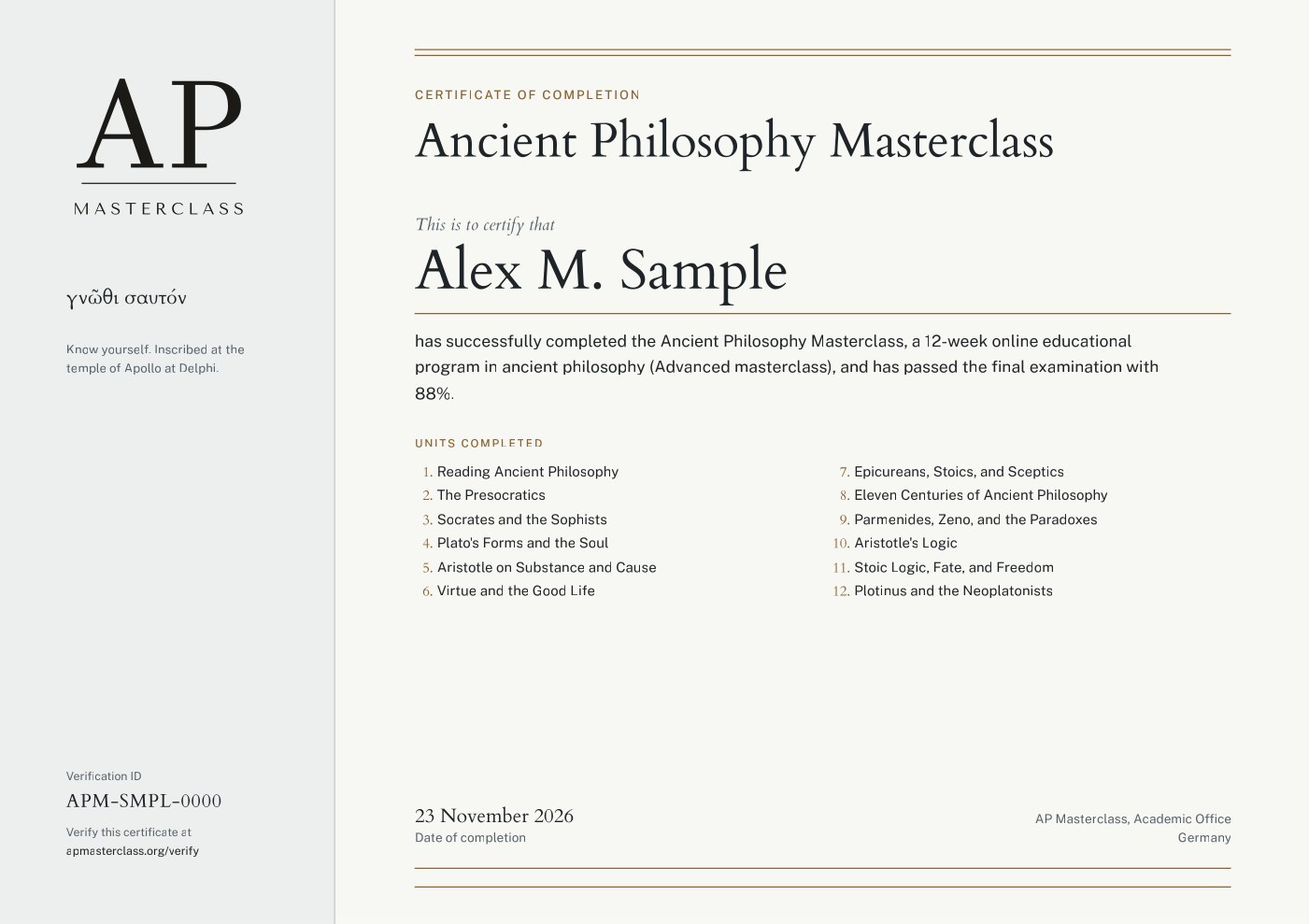
Sample certificate of the Ancient Philosophy Masterclass

Your certificate

Participants who pass the final exam receive an official certificate of completion. It states your name, the program, its duration, and the units you completed.

  • Certificate and transcript. The transcript lists your score in every unit quiz and in the final exam.
  • Verifiable. Both documents carry a verification ID that can be checked on this website.
  • Shareable. Your personal verification link shows your result to universities and employers.

Sample unit

Read one complete unit before you enrol, exactly as participants receive it: the full text with its passages, arguments, Close Readings, and research spotlight.

The Death of Socrates by Jacques-Louis David, 1787: Socrates, sitting on his bed in the prison, reaches for the cup of hemlock and raises his other hand as he speaks, while his friends grieve
Jacques-Louis David, The Death of Socrates, 1787. Oil on canvas, The Metropolitan Museum of Art, New York. CC0
AP MasterclassUnit 3

Socrates and the Sophists

By the end of this unit, I should be able to answer these questions:

  1. Why do Plato, Xenophon, and Aristophanes give us three different pictures of Socrates, and which one do historians trust?
  2. Who were the Sophists, what did Protagoras and Gorgias teach, and why were Athenians willing to pay them?
  3. How does a Socratic refutation work, step by step, in the Euthyphro?
  4. What did Socrates claim to know, and why is "I know that I know nothing" a misquotation?
  5. What were the charges against Socrates in 399 BC, and how does Plato's Apology answer them?

ho the Sophists were and what they taught for money, how Socrates refuted the people he questioned, and why Athens put him on trial in 399 BC. The unit works through a Socratic refutation in the Euthyphro step by step, reads what Socrates actually claimed to know, and follows the Apology to the verdict. By the end the participant takes apart a Socratic argument themselves.

1

Unit 3

Socrates and the Sophists

Three pictures of one man, the method of refutation, and the trial of 399 BC.

Unit 3 is being prepared as the free sample unit. It will be published here as a web page and as a PDF.

Roman mosaic from Pompeii, 1st century BC, showing seven philosophers in discussion under a tree, often called Plato's Academy (National Archaeological Museum, Naples)
Mosaic of seven philosophers in discussion, often called Plato's Academy. Pompeii, 1st century BC, National Archaeological Museum, Naples. Photo: Marie-Lan Nguyen, Public domain

Academic community

Masterclass participants come from all over the world, and when you complete the program you stay part of a network that keeps you close to philosophy.

Philosophy academics in our community
2500+
Countries represented
90+
Schools and universities represented
750+

Agora-Connect

Our alumni program connects former participants across countries: for study advice, exchange about university applications, and shared reading groups and projects.

Opportunities

Past participants hear from us about scholarships, essay competitions, summer schools, and other academic opportunities in philosophy and classics.

A place in the field

The program shows you how scholars work on ancient texts and where that work happens, so that your next step, at school, at university, or beyond, is an informed one.

Frequently asked questions

All questions

Who is this program for?

For high school students, university students, and lifelong learners. High school students use it to learn how an argument is read and written before they apply for philosophy, classics, law, or politics, and to prepare for the philosophy olympiad or an essay competition. University students take it alongside a degree, to have the ancient texts in order before a seminar on Plato or Aristotle. Lifelong learners, among them many who came to the Stoics through Marcus Aurelius, use it to read the originals properly. The Foundation masterclass suits a first contact with the subject; the Advanced masterclass goes on to Zeno's paradoxes, Aristotle's logic, the Stoic theory of fate, and Plotinus.

What do I need to know before I start? Do I need Greek or Latin?

Nothing about philosophy, and no Greek, Latin, Sanskrit, or Chinese. Every passage is quoted in English translation, and every Greek word a unit uses is given in our alphabet with its meaning. Unit 1 explains how the ancient texts reached us, how a passage is cited (Republic 514a, Nicomachean Ethics 1094a1), how an argument is set out as premises and a conclusion and judged valid or sound, and the twenty Greek words that the later units use. The little mathematics in the program (the sum of Zeno's series in Unit 9, a four-line truth table in Unit 11) is school level and shown step by step.

How much time does a unit take, and are there live sessions?

Most participants spend three to five hours a week: two or three sessions of reading and one for the quiz. The further reading is optional and goes beyond what the quiz and the final exam ask. The program is fully online and has no live sessions, so it works in every time zone and next to school or work. You receive the units by email and read them on the website or as PDF; quizzes and the final exam are taken on the website.

Can I finish the program in less than 12 weeks?

Yes. A new unit is scheduled for every Monday, but once you have submitted the quiz of a unit you can ask for the next one ahead of schedule, from your dashboard or from the email we send you. The earliest moment is 24 hours after the previous unit was sent. We recommend the weekly rhythm, because the arguments need time to settle, but the pace is your decision.

What happens if I fall behind or have to pause?

Nothing is lost. The next unit is only sent once you have submitted the quiz of the current one, so the program waits for you. You can pause for a week or for a few months and continue at any time. There is no penalty and no deadline.

How does the final exam work?

After the last unit you sit the final exam online: 50 multiple-choice questions across all your units, drawn individually for each participant, with a time limit of 60 minutes. It is open book. You pass with 70% correct answers. If you do not pass, you can try again after 3 days with new questions, up to 3 attempts in total.

γνῶθι σαυτόν

Know yourself. Inscribed at the temple of Apollo at Delphi.

Begin your 12 weeks with the ancient philosophers

The Acropolis of Athens lit at dusk under a deep blue sky, with the Parthenon on the summit, seen from the Pnyx hill
The Acropolis of Athens at dusk, seen from the Pnyx, where the Athenian assembly met. Photo: George E. Koronaios, 2 March 2020, CC BY-SA 4.0