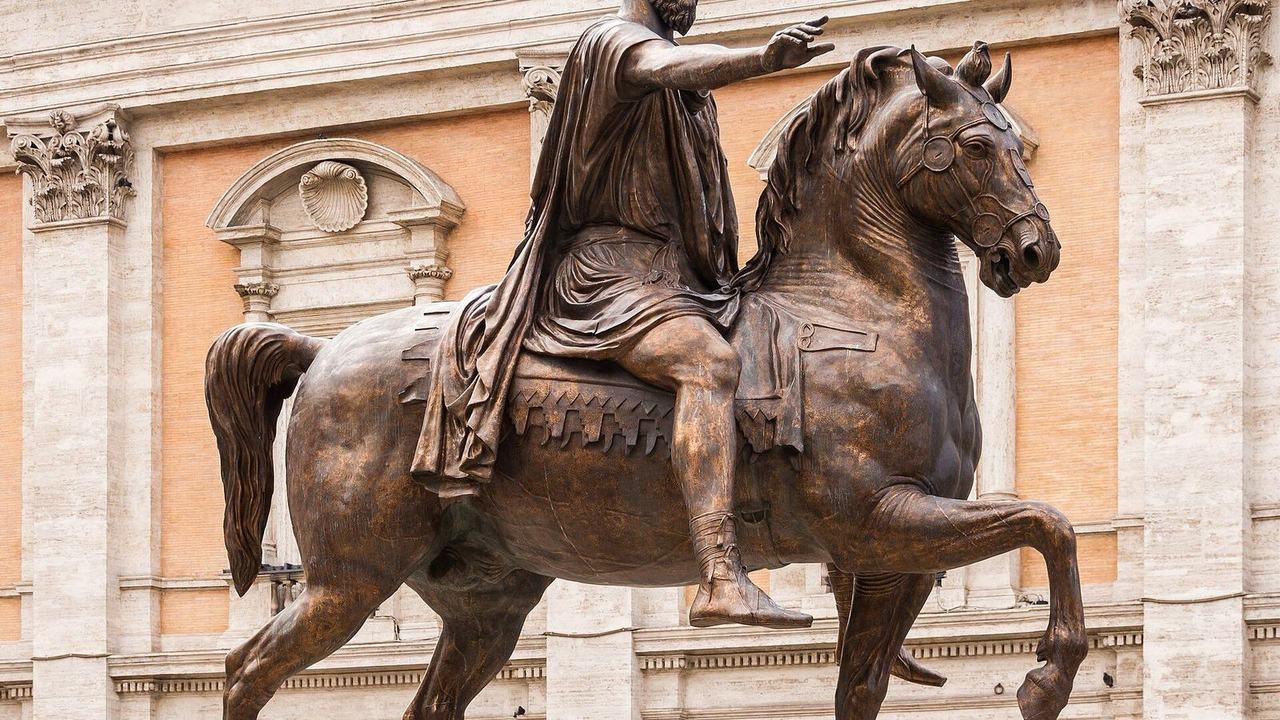
 Image: Replica of the equestrian statue of Marcus Aurelius on the Capitoline Hill, Rome. Photograph by Jebulon, CC0, via Wikimedia Commons
What Marcus Aurelius meant: how to read the Meditations
The book has no title in the manuscripts. The Greek heading that editors use, Ta eis heauton, means the things to himself, and it describes what the book is better than the English word Meditations does. Marcus Aurelius, emperor of Rome from AD 161 until his death in 180, wrote these short paragraphs for his own use, most of them during the last decade of his life, while he commanded the armies fighting the Germanic tribes on the Danube. Two of the twelve books carry a note of where they were written: the second among the Quadi, on the river Gran, the third at Carnuntum, a legionary base near modern Vienna. He wrote in Greek, the language of philosophy, although his own first language was Latin.
Not a book, in the ordinary sense
Nothing suggests that Marcus meant anyone else to read the notes. There is no preface, no argument that runs from one book to the next, and no attempt to avoid repetition: the same thought comes back dozens of times in slightly different words. The first book is different in kind, a list of the people to whom he owes something and what he learned from each, from his grandfather to the gods. The rest are exercises. A reader who opens the Meditations expecting a treatise on Stoicism will find it disordered. A reader who opens it expecting to watch a man practising will find it exact.
The practice is Stoic. Marcus had read Epictetus, whose lecture notes his teacher Rusticus had lent him (1.7), and the framework of the Meditations is the one Epictetus taught: some things are up to us and some are not, and the whole work of philosophy is to want only what is up to us. Pierre Hadot, in The Inner Citadel (1992 in French, 1998 in English), showed that nearly every paragraph of the Meditations can be read as an exercise in one of three disciplines, which Epictetus had also named: the discipline of assent, which concerns how we judge our impressions; the discipline of desire, which concerns what we want and fear; and the discipline of action, which concerns how we treat other people. Marcus is not describing these disciplines. He is doing them, on paper, one more time.
Meditations 4.3
The paragraph most often quoted is 4.3, and it shows the method. Marcus begins by observing that people look for retreats, in the country, by the sea, in the hills, and that he himself has longed for them. It is foolish, he says, since you can retreat into yourself at any hour. Nowhere is a person quieter or freer from trouble than in his own soul, above all if he has within him the kind of thoughts that bring him at once into perfect calm. So he tells himself to take this retreat often and to renew himself with short, basic principles that will wash away all his distress.
Then he lists the principles, each in a few words, as reminders of things already worked out. That people do wrong because they are ignorant of good and evil, so that one should be patient with them. That the universe is either providence or atoms, and that in either case one should not be disturbed. That the things that happen to the body do not touch the mind. And then the sentence that appears on so many posters: the universe is change, life is opinion. In Greek, ho kosmos alloiōsis, ho bios hypolēpsis. Read in its place, it is not a motto; it is a compressed reminder of two Stoic doctrines, that everything material is in constant transformation and that what we call our life is made of the judgements we form, so that changing the judgement changes the life. The paragraph ends by telling him to remember that the only thing that is his is the present moment, and to go back to work.
What to do with the famous lines
Because the paragraphs are short and quotable, the Meditations have been strip-mined for mottoes. The lines survive the process, but they lose their function. In the book every striking sentence is a tool with a job: to be repeated by a specific man at a specific moment of impatience or grief, so that the judgement behind the feeling can be examined and, if it fails the test, dropped. You get more from a line by asking what judgement it was meant to correct than by admiring it. When Marcus writes that the best revenge is not to be like the man who wronged you (6.6), the judgement under correction is that revenge is worth having. When he writes that a cucumber is bitter, throw it away; there are brambles in the path, step aside (8.50), the judgement under correction is that the world owes him smooth paths.
A second thing to notice is how often Marcus fails and says so. He reproaches himself for distraction, for anger, for wanting fame, for not being the philosopher he intended to become. The book is not the record of a serene man. It is the record of a man working at serenity under a great deal of pressure, and the pressure is in the text: the plague that reached the empire in 165, the war that took him to the Danube in 170, the revolt of his general Avidius Cassius in 175, the deaths of most of his children. None of that is narrated. All of it is there.
How the book survived
The Meditations were nearly lost. A few writers of late antiquity seem to know them; then silence until the tenth century, when the Byzantine scholar Arethas mentions owning a copy. The first printed edition appeared in Zurich in 1559, made by Wilhelm Xylander from a manuscript that has since disappeared. One complete manuscript survives, in the Vatican Library, written in the fourteenth century, and it and the lost one behind Xylander's edition are the two legs the text stands on. For a book that is now printed in every language, that is a thin thread, and Unit 8 of the masterclass, which follows the ancient texts to the printed page, uses it as an example of how close the margin can be.
Reading it with the masterclass
Units 7 and 11 give the Stoic doctrines that the Meditations assume and never explain: the division of things into what is up to us and what is not, the theory of impressions and assent, the account of fate, and the idea of the cosmos as one living thing of which each person is a part. Read a book of the Meditations after Unit 7 and the reminders stop being aphorisms and become applications. The citations in the units follow the standard numbering by book and paragraph, which is the same in every edition, so Meditations 4.3 is 4.3 in your copy. The Stanford Encyclopedia's article on Marcus Aurelius by Rachana Kamtekar sets out the philosophy with the passages, and the Internet Encyclopedia's article on Marcus Aurelius covers the life.
The translation matters more than for most ancient texts, because the Greek is compressed and a translator's choices decide the tone. George Long's version of 1862 is in the public domain and still readable; it is the one the masterclass quotes when it does not translate for itself. Among modern versions, Robin Hard's and Martin Hammond's stay close to the Greek. Whichever you choose, read a book at a sitting, not a line at a time. The repetitions are the point.