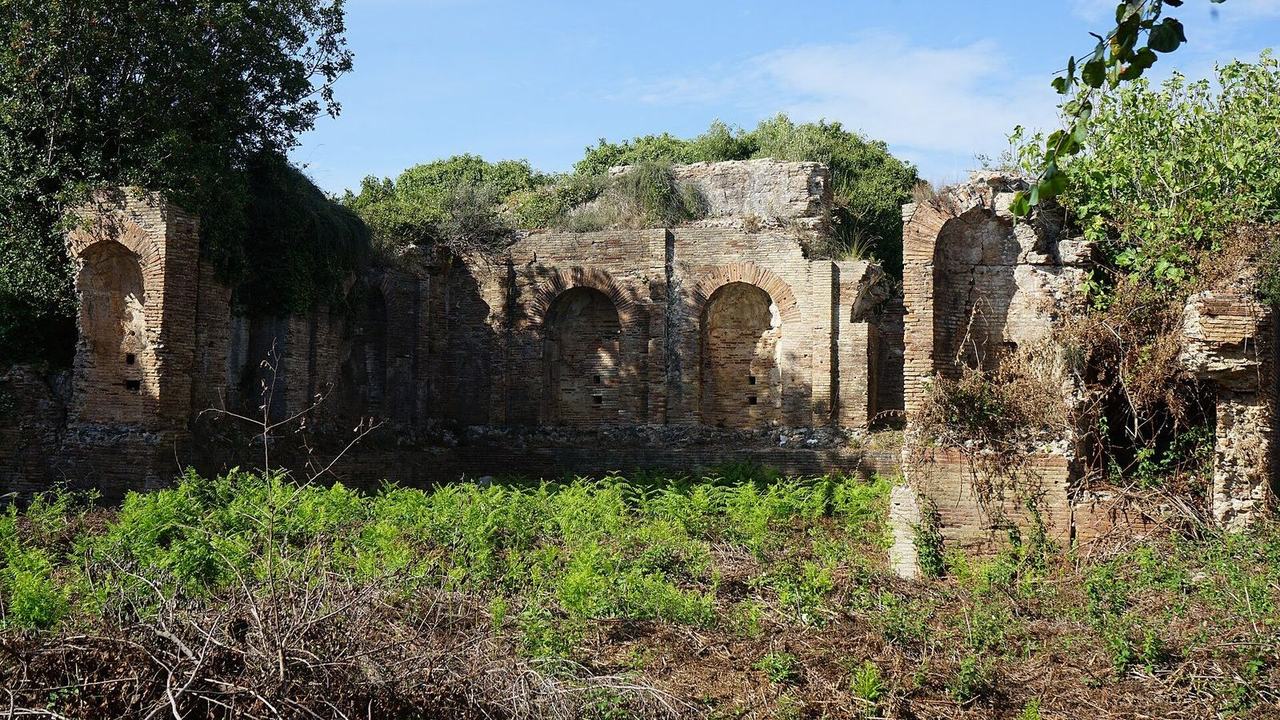
 Image: The northern nymphaeum at the west gate of Nicopolis in Epirus, where Epictetus taught. Photograph by Albinfo, CC0, via Wikimedia Commons
Who was Epictetus? The Stoic who was born a slave
The Greek word epiktētos means acquired, or bought. It is the kind of name an owner gave a slave, and the man who carried it never used another. He was born about AD 50 in Hierapolis, a town in Phrygia in what is now western Turkey, and came as a slave to Rome, where his master was Epaphroditus, himself a former slave who had risen to be a secretary of the emperor Nero. We do not know how or when Epictetus was freed. We know that while still a slave he was allowed to attend the lectures of the Stoic Musonius Rufus, that he was lame, and that he spent the rest of his life teaching that a person's freedom does not depend on anyone else.
The sources
Epictetus wrote nothing. What we have is the work of a pupil, Arrian of Nicomedia, who attended his lectures as a young man around AD 108, took them down, and published them. Arrian later became a Roman consul and a historian, the author of the standard account of Alexander the Great, and in a letter prefixed to the lectures he says that he wrote down what he heard as far as he could in Epictetus' own words, to keep a record of his teacher's mind and frankness. The result is the Discourses, eight books of which four survive, and the Handbook (Encheiridion), a short selection of the essential points. The Discourses are in the plain Greek of conversation, with questions from the students, interruptions, jokes, and the teacher losing his temper. Nothing else from antiquity gives so direct a picture of a philosophy classroom.
The biographical facts come from scattered remarks in those lectures and from later writers. The lameness is mentioned by Epictetus himself, by the Christian writer Origen, who records a story that his master broke his leg, and by Simplicius, who wrote a commentary on the Handbook in the sixth century and says simply that he was lame from childhood. The sources disagree and the question cannot be settled. The masterclass reports it as the sources do.
Nicopolis
Around AD 93 the emperor Domitian expelled the philosophers from Rome, and Epictetus, by then free and teaching, left for Nicopolis in Epirus on the west coast of Greece. The town had been founded by Augustus to mark his victory at Actium in 31 BC, and it was the main port between Italy and Greece, so a teacher there had a steady supply of young Romans on their way to or from the provinces. Epictetus opened a school and stayed until his death, about AD 135. The ruins of Nicopolis, with its walls, theatre, and the nymphaea at the west gate, lie a few kilometres north of the modern town of Preveza and are open to visitors. No building has been identified as the school.
The students were young men of the governing class, preparing for careers in the army, the law, and the administration, and the lectures address them as such. Epictetus does not ask them to give up their careers. He asks them to see which parts of those careers are theirs to control and which are not.
What is up to us
The Handbook opens with the sentence on which everything else rests: some things are up to us and some are not. Up to us are belief, impulse, desire, and aversion, in short everything that is our own doing; not up to us are the body, property, reputation, and office, in short everything that is not our own doing. The Greek phrase is to eph' hēmin, and Unit 7 of the masterclass glosses it at first use and then uses it throughout, because the whole of Epictetus' ethics is an application of the distinction.
The application is strict. Your body is not up to you, since illness, injury, and death come whether you consent or not. Your reputation is not up to you, since it lies in other people's heads. What is up to you is how you judge these things, and the claim is that every disturbance in a human life comes from judging something not up to us to be good or bad. Remove the judgement and the disturbance goes. People, Epictetus says in Handbook 5, are disturbed not by things but by their judgements about things: death is nothing terrible, or Socrates would have thought so; what is terrible is the judgement that death is terrible.
This is harder than the posters make it look, and the Discourses are honest about that. Epictetus describes a student who has mastered the theory of what is up to us and then flinches when a sea voyage turns rough. The point of the school is practice: to work on one's impressions, as he calls it, every day, until the judgement comes right without effort. The Stoic technical vocabulary behind this, impressions, assent, and the commanding part of the soul, is set out in Unit 11, and the Internet Encyclopedia of Philosophy's article on Epictetus by Keith Seddon goes through it with the text addresses.
The slave on freedom
Freedom is the subject of the longest of the Discourses, 4.1, and a former slave writing on it is not a coincidence that readers have missed. Epictetus' argument is that legal freedom is not the kind that matters. A free citizen who wants what is not up to him, who is afraid of the emperor or of losing his money, is a slave to those fears; a slave who wants only what is up to him is free. The argument is sharp enough that it was later used both to console the enslaved and to tell them to accept their condition, and a reader should notice that Epictetus himself drew neither conclusion. He says that a slave's body is not up to him; he says the same of the emperor's.
An emperor's reading
The best-known reader of Epictetus was Marcus Aurelius, emperor from AD 161 to 180, who never met him. In the first book of the Meditations (1.7) Marcus thanks his teacher Junius Rusticus for lending him his own copy of the notes of Epictetus, and the Meditations quote the Discourses several times. The Stoicism of the Meditations, with its three disciplines of judgement, desire, and action, is Epictetus' framework taken over by a man at the opposite end of the social order. The emperor Hadrian is also said to have been on friendly terms with him, though the source for that, the Historia Augusta, is not one to lean on.
Later readers were as varied. Simplicius, a pagan Neoplatonist, wrote a commentary on the Handbook. Christian monks adapted it, replacing Socrates with Paul. In 1759 the Handbook was one of the few philosophical texts to be translated into English by a woman, Elizabeth Carter, whose version of all the surviving works stayed in print for a century and a half. The Stanford Encyclopedia of Philosophy's article on Epictetus by Margaret Graver follows the afterlife in detail.
Reading him now
Start with the Handbook, which takes an hour, and then read the first book of the Discourses, which takes an evening. The chapter numbers are the same in every edition, so the masterclass cites Discourses 1.1 and Handbook 5 and you can find them in any translation. Expect to be addressed as a student who has not yet done the work. That was the audience, and it is still the right way to read him.