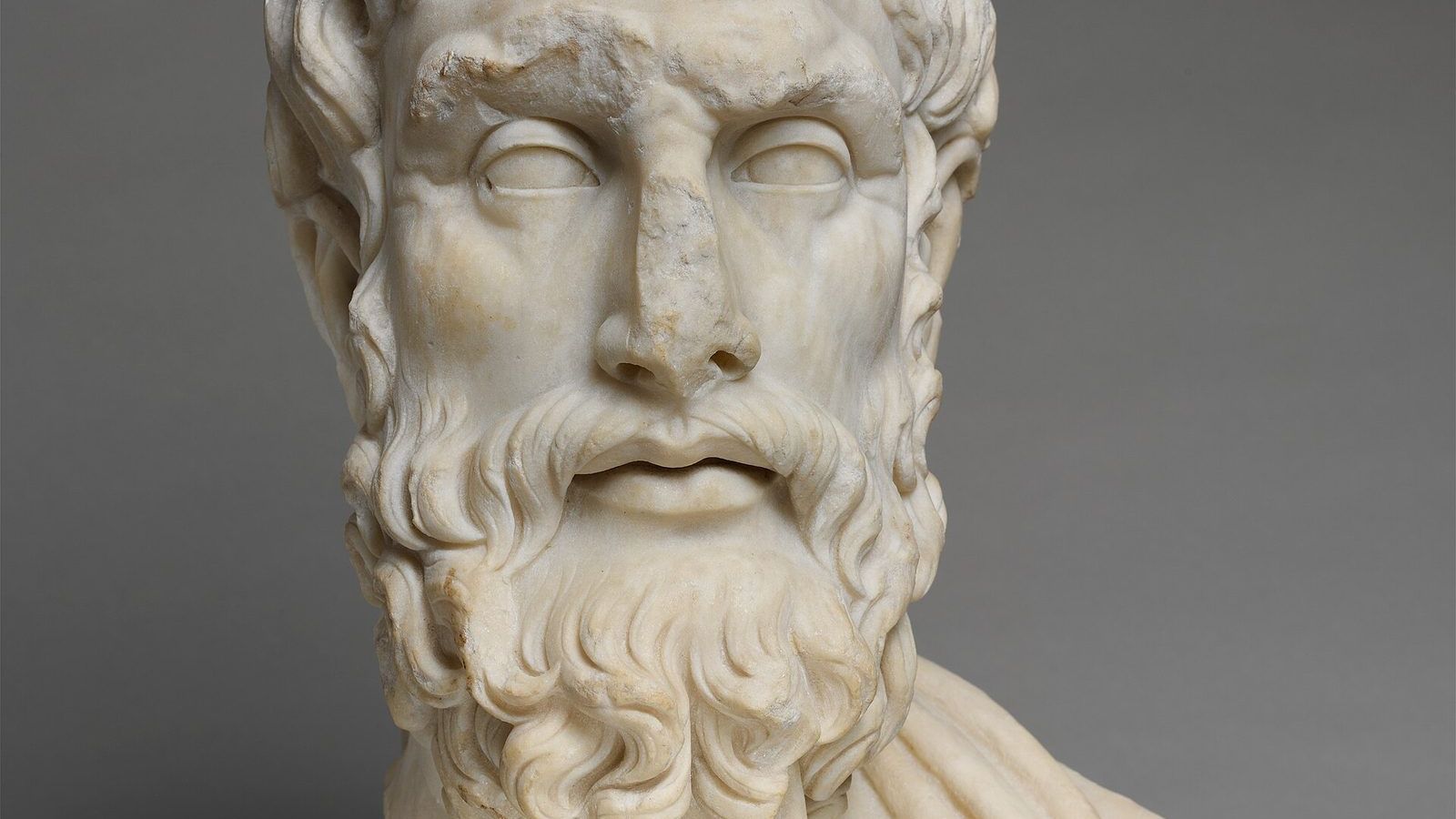
 Image: Marble bust of Chrysippus, Roman copy of a Hellenistic original, Altes Museum, Berlin. Photograph by Osama Shukir Muhammed Amin, CC BY-SA 4.0, via Wikimedia Commons
Chrysippus, Hipparchus, and the number of conjunctions
Plutarch, writing around AD 100, records a dinner-table conversation in his Table Talk (8.9, 732f) in which someone mentions a claim of Chrysippus, the third head of the Stoic school, who had died around 206 BC. Chrysippus had said that the number of conjunctions that can be made from only ten assertibles exceeds a million. The arithmeticians, Plutarch's speaker goes on, refuted him: Hipparchus showed that the affirmative gives 103,049 conjoined assertibles and the negative 310,952. Hipparchus was the astronomer who discovered the precession of the equinoxes and compiled the first star catalogue, and his correction was taken for two thousand years as a case of a mathematician putting a logician right.
What was being counted
An assertible, in Stoic logic, is what a declarative sentence says: it is day, it is light, Dion is walking. A conjunction joins assertibles with and. Chrysippus' question is how many different conjunctions can be built from ten of them, and the answer depends on what counts as different. If a conjunction of ten things is just the set of things joined, there is only one. If order matters, there are 10 factorial, which is 3,628,800, and that is more than a million. If what matters is how the conjuncts are grouped, the count is different again. Nobody in antiquity explained which count Hipparchus made, and his two numbers stood in Plutarch's text as a puzzle. They looked like nothing in particular.
1994
In 1994 David Hough, a graduate student in mathematics, read the passage and noticed that 103,049 is the tenth Schröder number. The Schröder numbers, named after Ernst Schröder, who studied them in 1870, count among other things the number of ways of putting brackets into a string of n symbols so as to group them, where a group may have any number of members and the whole string counts as one grouping. For ten symbols the number is 103,049. Hough told Richard Stanley at the Massachusetts Institute of Technology, and Stanley published the observation in 1997 in the American Mathematical Monthly under the title Hipparchus, Plutarch, Schröder, and Hough. The paper is three pages long and is free to read on Stanley's own site.
So Hipparchus had counted the ways of grouping ten assertibles with brackets, treating a conjunction of ten as a string of ten that can be bracketed in any way: (a and b) and c, a and (b and c), and so on, up to arbitrary depth. That is a serious piece of combinatorics for the second century BC, and until 1994 nobody knew that Greek mathematicians had done anything of the kind. The second number was explained in 1998 by Laurent Habsieger, Maxim Kazarian, and Sergei Lando: 310,952 is half the sum of the tenth and eleventh Schröder numbers, which is what you get if you allow a negation to be placed either over the whole conjunction or over one of its bracketed parts, with the conventions Hipparchus seems to have used. The two numbers in Plutarch, meaningless for two millennia, turned out to be exact.
2011
That settled the mathematics and reopened the logic. If Hipparchus was counting bracketings, was he counting what Chrysippus had asked about? Susanne Bobzien of the University of Oxford argued in 2011 that he was not. Her paper, The Combinatorics of Stoic Conjunction: Hipparchus Refuted, Chrysippus Vindicated, published in Oxford Studies in Ancient Philosophy, goes back to what the Stoics meant by conjunction and assertible. A Stoic conjunction, she shows from the sources, is not a bracketed string; it is a flat list of conjuncts, and the Stoics did not distinguish (a and b) and c from a and (b and c). What they did distinguish was the assertibles themselves, including negated ones and conjunctions used as conjuncts, and under their rules the number of distinct conjunctions that can be formed from ten simple assertibles, counting the different ways of negating and combining them, does exceed a million.
On that reading Hipparchus answered a different question from the one Chrysippus had asked. His arithmetic was right and his logic was not Stoic. The paper is free to read on the site of Oxford Studies in Ancient Philosophy, and Unit 11 of the masterclass presents it as its Research Spotlight, because it shows something the unit wants to show in any case: that Stoic logic has rules of its own, that they are recoverable from the fragments, and that getting them right changes the verdict on a two-thousand-year-old argument.
Why Chrysippus was counting at all
The claim was not a party trick. Chrysippus built the Stoic logic as a logic of whole sentences joined by if, or, and and, in contrast with Aristotle's logic of terms, and he needed to know how the connectives behaved. The five basic argument forms, the indemonstrables, which the masterclass sets out in Units 7 and 11, are all about such compounds: if the first, then the second; the first; therefore the second. A logician who wants to show that his system covers every argument of a given kind has to be able to say how many such arguments there are. Diogenes Laertius (7.180) says that Chrysippus wrote more than 705 books, and the surviving titles include works on conjunctions, on the number of conclusions, and on the combinations of assertibles. The million was a result from one of those.
The same Diogenes reports (7.183) a saying that if the gods used dialectic, they would use Chrysippus'. None of the 705 books survives complete. What we know of his logic comes from quotations in Sextus Empiricus, Diogenes, Cicero, and Galen, and from passages like Plutarch's, where a remark preserved for its oddity turns out, when the mathematicians and the philosophers have both had their turn, to be the tip of a system.
Trying it
You can check the smallest Schröder numbers by hand. For two symbols there is one bracketing, ab. For three there are three: abc, (ab)c, and a(bc). For four there are eleven. Write them out and you will see why the numbers climb so fast. The sequence runs 1, 1, 3, 11, 45, 197, 903, 4279, 20793, 103049, and the tenth term is the one Hipparchus found. He had no notation for brackets. How he did it is not known, and that is the kind of question Unit 11 ends with: a result we can verify and a method we have lost.