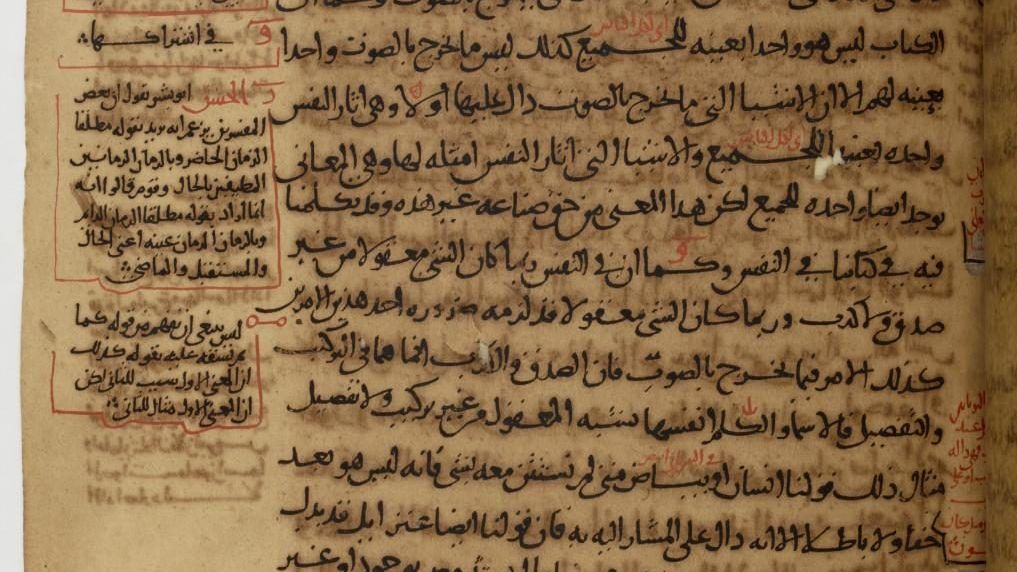
 Image: A page of the Arabic Organon of Aristotle, Bibliothèque nationale de France, MS arabe 2346, public domain, via Wikimedia Commons
How Aristotle got to Baghdad: the Arabic translations
Aristotle died in 322 BC. By AD 950 a philosopher in Baghdad, al-Farabi, was known as the second teacher, the first being Aristotle, and he had read the whole of the logic, the Physics, the Metaphysics, and the Nicomachean Ethics in Arabic. A manuscript in Paris, Bibliothèque nationale arabe 2346, copied in the eleventh century, contains the complete Organon, Aristotle's six works on logic, in Arabic with the notes of the Baghdad scholars who had studied it. How a text got from a lecture room in Athens to that manuscript is a story in three languages.
Greek to Syriac
The first stage happened inside the Roman Empire. Syriac, a form of Aramaic, was the language of the Christian churches of Syria and Mesopotamia, and from the fifth century their scholars translated Greek texts for their schools: the Bible first, then the Church Fathers, then the logic they needed to argue theology. Sergius of Reshaina, a physician and priest who died in 536, translated Galen and wrote on Aristotle's Categories in Syriac. By the seventh century the first three books of the Organon, the Categories, On Interpretation, and the first part of the Prior Analytics, existed in Syriac and were taught in the monasteries of northern Mesopotamia. The rest of the logic was thought dangerous and left alone.
The Syriac translators mattered for two reasons. They developed a technical vocabulary for Greek philosophy in a Semitic language, which the Arabic translators later borrowed and adapted. And they survived the Arab conquest of the 630s and 640s as a community of scholars whose skills the new rulers could use.
The Baghdad translation movement
The Abbasid caliphs moved the capital to Baghdad in 762, and for the next two centuries the city paid for the translation of nearly everything in Greek that was thought useful: medicine, astronomy, mathematics, and philosophy. Dimitri Gutas, in Greek Thought, Arabic Culture (1998), showed that this was not the work of a few enthusiasts but a sustained effort funded by the court, by officials, and by merchants, who paid translators well and sent agents into Byzantine territory to buy manuscripts. The library known as the House of Wisdom was part of it, though a smaller part than the legend has made it.
The best-known translator was Hunayn ibn Ishaq (809 to 873), a Christian from al-Hira who learned Greek, collected manuscripts, compared them to establish a sound text, translated into Syriac, and then had the Syriac turned into Arabic, often by his son Ishaq ibn Hunayn (died 910 or 911). Ishaq's Arabic versions of the Categories, On Interpretation, the Physics, and the Metaphysics became the standard ones. The circle around the philosopher al-Kindi produced earlier and rougher translations, including a paraphrase of Plotinus that circulated as the Theology of Aristotle and caused a great deal of confusion about what Aristotle had believed. By the early tenth century Abu Bishr Matta ibn Yunus, a Christian logician in Baghdad, had translated the Posterior Analytics and the Poetics from Syriac, and the Arabic Organon was complete.
The translators worked from Greek manuscripts that are now lost, which is why their versions are still used by editors of the Greek text. Where an Arabic translation of the ninth century reads differently from the Greek manuscripts of the tenth, the Arabic may preserve the older reading.
What the Arabic philosophers did with him
Translation was the beginning. Al-Farabi (died about 950) wrote commentaries on the whole logic and tried to show that Plato and Aristotle agreed. Avicenna (Ibn Sina, died 1037) rebuilt the system in his own encyclopaedic works and became, for the Islamic world, the philosopher whom later writers read instead of Aristotle. Averroes (Ibn Rushd, died 1198), working in Córdoba and Marrakesh, wrote commentaries on nearly every work, at three lengths, with the aim of recovering Aristotle's own meaning from under Avicenna's rebuilding. In the Latin West he was called simply the Commentator, and his commentaries were printed in the margins of Aristotle's text in the Venice editions of the sixteenth century.
None of this was passive. The Arabic philosophers argued with Aristotle on the eternity of the world, on the nature of the intellect, and on whether his logic could be reconciled with Arabic grammar, a famous debate in Baghdad in 932 between Abu Bishr Matta and the grammarian al-Sirafi. The Stanford Encyclopedia's article on the Greek sources of Arabic and Islamic philosophy by Cristina D'Ancona lists what was translated, by whom, and when.
The road back
Latin Europe in the year 1100 had two of Aristotle's works, the Categories and On Interpretation, in the translations of Boethius from about 510. Everything else came in the twelfth and thirteenth centuries by two routes. One was direct from Greek: James of Venice translated the Posterior Analytics, the Physics, and On the Soul from Greek manuscripts in Constantinople around 1125 to 1150, and William of Moerbeke, a Flemish Dominican, revised or made Latin versions of almost the whole corpus from Greek between about 1260 and 1280 at the request of Thomas Aquinas. The other route was from Arabic, through the cities of Spain that had passed from Muslim to Christian rule. In Toledo, from the 1140s, Gerard of Cremona translated the Physics, On the Heavens, and the Posterior Analytics from Arabic, and in the 1220s Michael Scot translated Averroes' commentaries with the text of Aristotle embedded in them.
So the Aristotle that the universities of Paris and Oxford argued over in the thirteenth century came by both roads at once, sometimes in two Latin versions of the same work, one made from Greek and one from Arabic by way of Syriac. Where they disagreed, scholars noticed, and the comparison of translations became a scholarly method. The Stanford Encyclopedia's article on the influence of Arabic philosophy on the Latin West follows the texts and the arguments they carried.
What the story corrects
Two pictures are still common and both are wrong. One has the Arabic scholars as mere custodians, keeping the Greek texts safe until Europe was ready for them. Three centuries of commentary, argument, and system-building are not custody. The other has the Greek texts lost in Europe and rediscovered only through Arabic. The Greek manuscripts never left Constantinople, and the most important Latin translations were made directly from them. What the Arabic route supplied was the first access to the Physics and the Metaphysics, decades earlier than the Greek route, and the commentaries of Averroes, without which the Latin readers would have had the text and no idea how to read it.
Unit 8 of the masterclass traces this road as one station of a longer line that runs from Andronicus of Rhodes editing Aristotle's lecture notes in the first century BC to Bekker's Berlin edition of 1831, whose page numbers every citation in the units uses. Unit 10, on Aristotle's logic, reads the Prior Analytics, the book that the Baghdad logicians knew by heart and that Abu Bishr Matta defended against the grammarians as a universal instrument of reason, in any language.