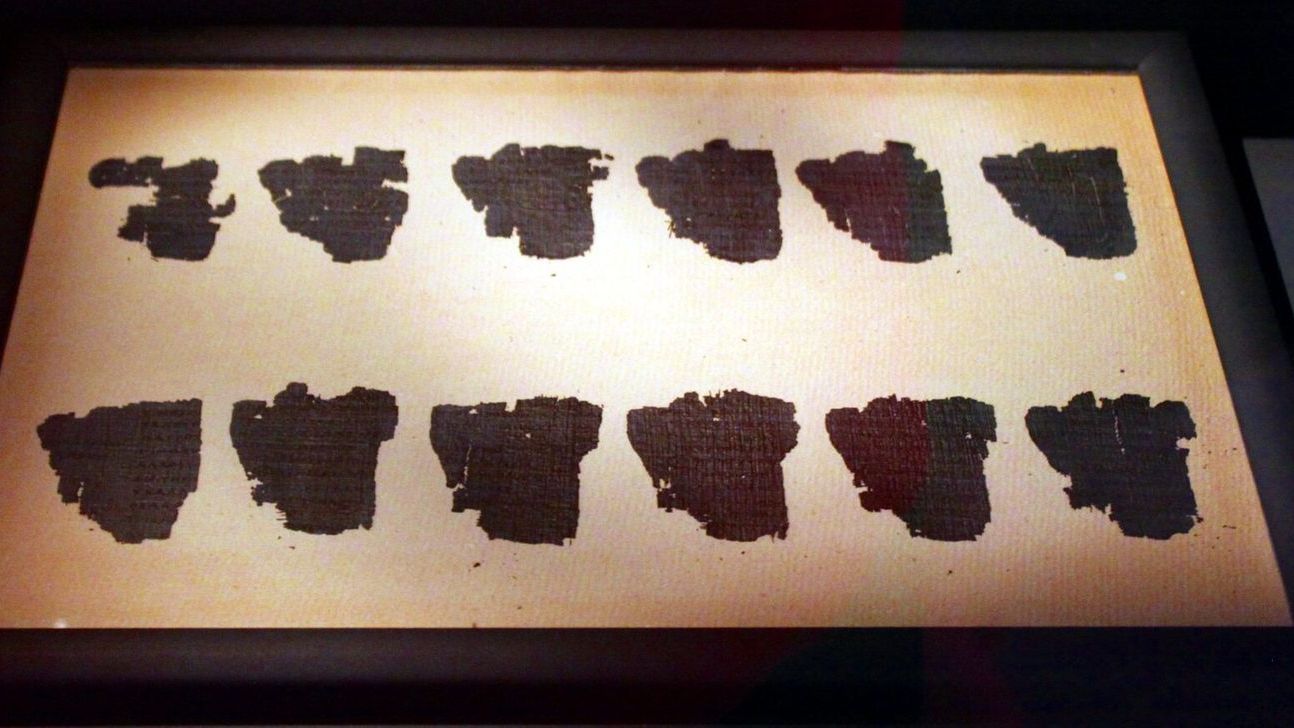
 Image: The Guodian bamboo slips of Laozi A, Jingmen Museum, Hubei. Photograph by Cangminzho, CC BY-SA 4.0, via Wikimedia Commons
What was found in the Guodian tomb: the oldest Laozi
Guodian is a village near Jingmen in Hubei province, in the territory of the ancient state of Chu. In October 1993, after tomb robbers had disturbed the site, archaeologists excavated a small tomb there, numbered Guodian Tomb 1. It belonged to a man of modest rank, perhaps a tutor at the Chu court, and it had been sealed around 300 BC, before the armies of Qin took the Chu capital at Ying in 278 BC. In the tomb, among the usual grave goods, were about 800 slips of bamboo, around 730 of them inscribed, carrying some 13,000 characters of text in the script of the Chu state. The robbers had taken nothing of them. Nobody had read them for twenty-three centuries.
What was on the slips
The slips were published in 1998 as Guodian Chumu zhujian, the Bamboo Slips of the Chu Tomb at Guodian, and scholars sorted them into sixteen texts. Three bundles, told apart by the length of the slips and the hand of the copyist, contained material that corresponds to the Daodejing, the Classic of the Way and Virtue, attributed to Laozi. They are called Laozi A, B, and C. Together they hold about 2,000 characters, which corresponds to some thirty-one of the eighty-one chapters of the received text, in a different order and with many differences of wording. Attached to bundle C was a short cosmological text never seen before, now called Taiyi sheng shui, The Great One Gave Birth to Water. The remaining texts were Confucian: a version of the Black Robes chapter that is also in the Book of Rites, a text on the five kinds of conduct called Wuxing, a treatise on human nature called Xing zi ming chu, Nature Comes from the Mandate, and several others.
Before 1993 the oldest known copies of the Daodejing were the two silk manuscripts from the Mawangdui tomb near Changsha, excavated in 1973 and sealed in 168 BC. Guodian pushed the date back by more than a century and into the lifetime of Zhuangzi. The Guodian material is not a complete Daodejing; whether the copyist had a complete one and selected from it, or whether the book had not yet reached its full form, is the central question the find raised, and it is still open.
What is different
The best-known difference is in the passage that became chapter 19 of the received text. The received version says: cut off sageliness, discard wisdom, and the people will benefit a hundredfold; cut off humaneness, discard rightness, and the people will return to filial piety and parental love. It is a direct attack on the two central Confucian virtues, ren and yi. The Guodian version of the same lines reads: cut off wisdom, discard disputation, and the people will benefit a hundredfold; cut off artifice, discard deliberation, and the people will return to filial piety and parental love. Humaneness and rightness are not attacked. On the usual reading this means that the hostility between the Laozi tradition and the Confucians, which is a settled feature of the later text, had not yet been written in, and that the Guodian Laozi was a text that could lie in the same tomb as the Black Robes without contradiction.
Other differences are smaller and add up. The Guodian text lacks the chapters that attack the Confucian virtues most sharply and the chapters on military strategy; it has nothing corresponding to chapter 1, the famous opening about the Way that can be spoken of. Several passages that are compressed to the point of obscurity in the received text are fuller and clearer on the slips. For a reader of Unit 16 of the masterclass, which cites the received text by chapter number, the practical lesson is that the chapter numbers are a product of a later arrangement, and that the sayings they contain circulated earlier in other orders and other combinations.
The Great One and water
The Taiyi sheng shui is fourteen slips long and describes an origin of the world that no transmitted text contains. The Great One gave birth to water; water returned and assisted the Great One, and so heaven was formed; heaven returned and assisted the Great One, and so earth was formed; and so on through the spirits, yin and yang, the four seasons, cold and heat, wet and dry, and the year. It is a cosmogony in which each stage turns back to help its source produce the next, and it was copied by the same hand on slips of the same length as Laozi C. Whether it was regarded as part of the Laozi, as a commentary, or as a separate text, is not known. It is the kind of thing that the units of the masterclass cannot cite from the received tradition at all, and Unit 16 presents it as an example of how much Warring States thought was never transmitted.
Why the Confucian texts matter as much
The Laozi slips got the headlines. For the history of Confucian philosophy the other texts may be more important, because they fill the gap between Confucius, who died in 479 BC, and Mencius, who was active in the fourth century. Xing zi ming chu argues that human nature comes from the mandate of Heaven and that the emotions arise from nature, and it discusses how music and ritual shape them; it is close to the questions Mencius asks and answers in a different way, and it may come from the circle of Confucius' grandson Zisi, to whom tradition attributes the Doctrine of the Mean. The Wuxing text was already known from the Mawangdui silk, where it has a commentary; Guodian showed that it was a century older than anyone had thought. Unit 15, on Confucius and Mencius, draws on both to show that the debate about human nature was under way before Mencius joined it.
Reading the texts
The slips themselves are in the Jingmen Museum in Hubei, and the photograph above shows the Laozi A bundle. The standard English edition of the Laozi material is Robert Henricks' Lao Tzu's Tao Te Ching: A Translation of the Startling New Documents Found at Guodian (2000), and Scott Cook's two-volume The Bamboo Texts of Guodian (2012) translates everything. Both are in copyright. The Stanford Encyclopedia's article on Laozi by Alan Chan describes the Guodian and Mawangdui finds and what they mean for the date and the authorship of the book, and the received Daodejing with Legge's translation is on the Chinese Text Project, where chapter 19 can be compared with the Guodian wording given above. The masterclass follows the convention of its author guide: Laozi is not a documented person, and when a unit says that Laozi says something, it means that the Daodejing says it, in whichever of its versions is being read.