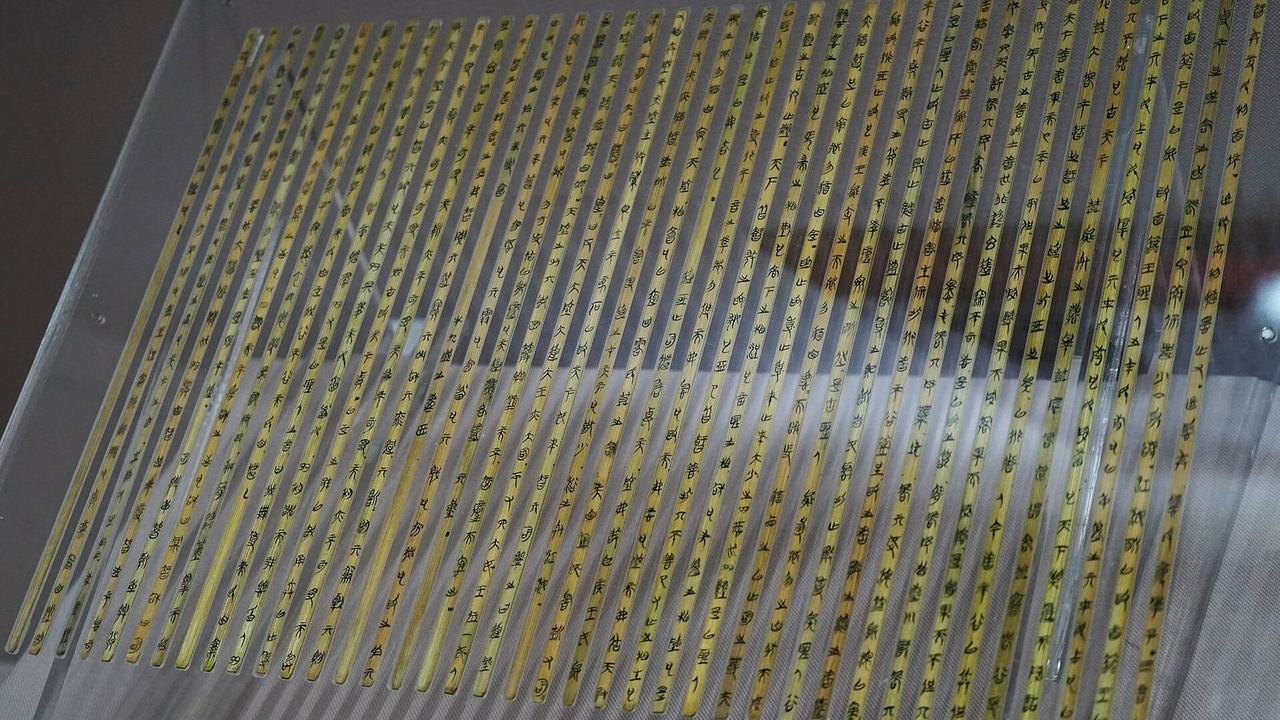
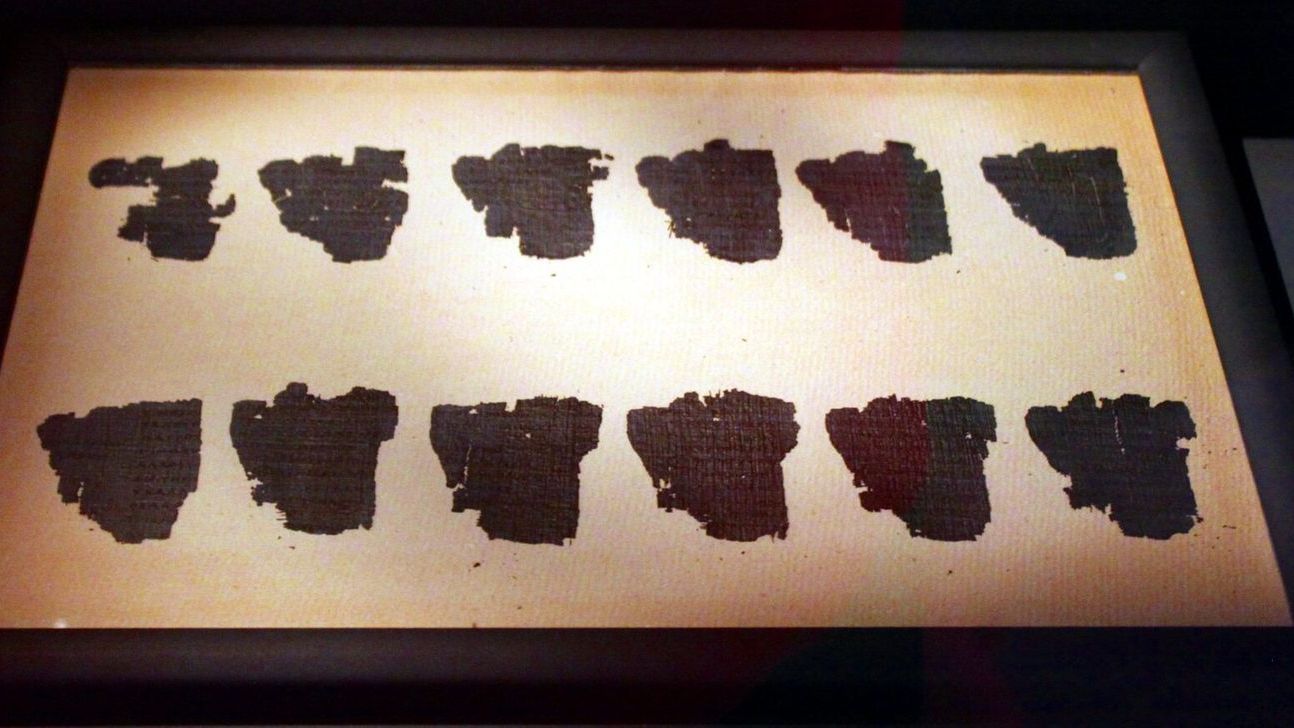
 Image: Fragment of a Herculaneum papyrus (PHerc. 362, Epicurus, On Nature) in the Papyrus Museum, Syracuse. Photograph by Derbrauni, CC BY 4.0, via Wikimedia Commons
What the Vesuvius Challenge read inside a Herculaneum scroll
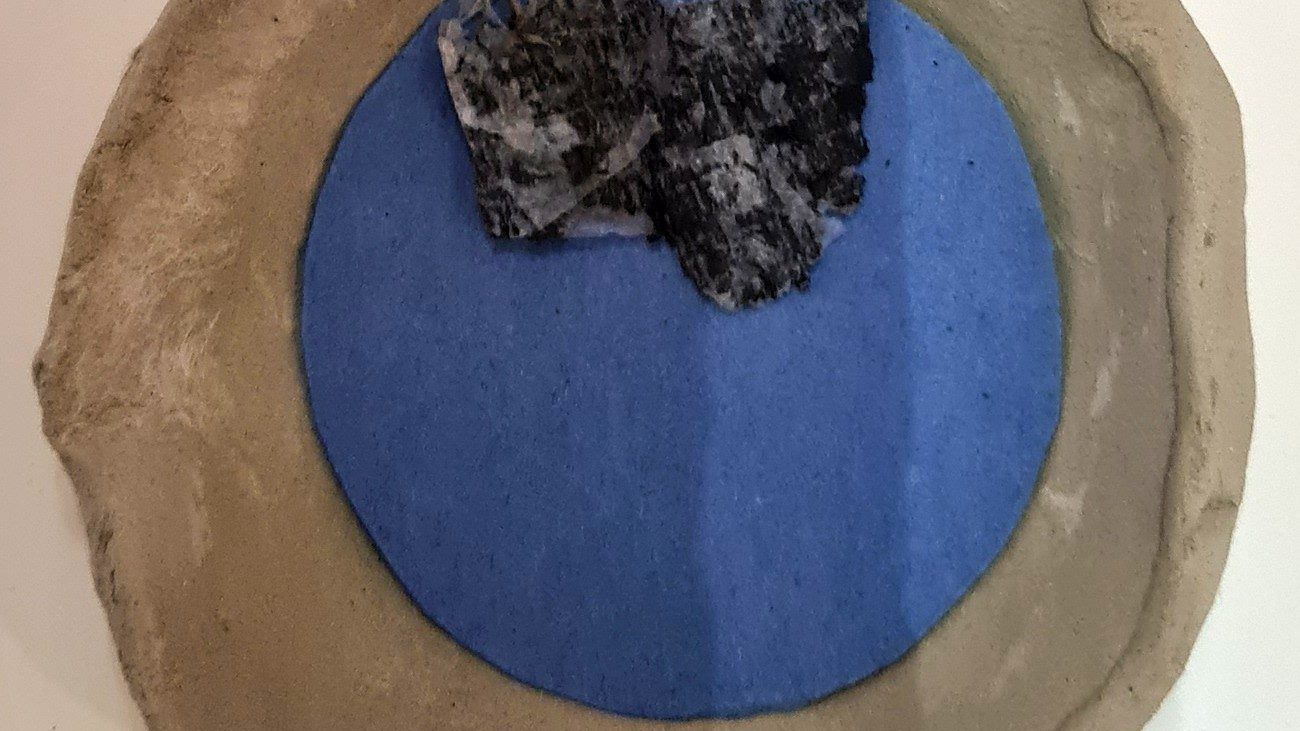
Between 1752 and 1754, workmen tunnelling into the buried town of Herculaneum, on the Bay of Naples, broke into a large villa and found what looked like lumps of charcoal. There were about 1,800 of them. They were papyrus rolls, carbonized by the hot gas and ash that buried the town when Vesuvius erupted in AD 79, and they are the only library of the ancient world that has survived as a library, on its shelves, in the house of its owner. Most of the rolls that have been read are Epicurean philosophy, many of them by Philodemus of Gadara, who worked in the villa in the first century BC.
Why the scrolls stayed closed
The eighteenth-century finders tried to open them. Some were cut open with knives and fell to pieces. In 1754 Antonio Piaggio, a priest from the Vatican library, built a machine that unrolled a scroll a few millimetres a day by hanging weights from threads glued to its outer layer. It worked, slowly, and it destroyed a great deal. The columns of Greek that it exposed were copied by draughtsmen, which is why for several texts the drawings are now the best evidence. By the twentieth century a few hundred rolls had been opened in whole or in part, several hundred more remained closed, and every known method of opening the rest would turn them to dust.
The question became whether a closed scroll could be read without opening it. W. Brent Seales, a computer scientist at the University of Kentucky, had spent two decades on that problem. In 2015 his group read the text of a charred scroll from En-Gedi in Israel by scanning it in a micro-CT machine, tracing the rolled surface through the scan, and flattening it digitally. The method was called virtual unwrapping. The Herculaneum scrolls were harder: the ink was carbon, like the papyrus around it, so it did not show up as a different density in the X-ray image the way the metallic ink of En-Gedi had.
The competition
In 2019 and again in 2023 Seales' team scanned Herculaneum scrolls at the Diamond Light Source, the particle accelerator near Oxford, at a resolution of a few micrometres. In March 2023 the scans were released as the Vesuvius Challenge, a competition with money prizes funded by the technology investors Nat Friedman and Daniel Gross and open to anyone. The first problem was to prove that ink could be detected at all. Casey Handmer, working from the images, noticed in June 2023 a faint cracked texture on some regions of the flattened surface and argued that it was ink. Luke Farritor, a student at the University of Nebraska, trained a machine-learning model to find that texture, and in August 2023 it produced the first word: πορφύρας, porphyras, purple. The result was announced on 12 October 2023 with the First Letters prize of 40,000 dollars; Youssef Nader, a doctoral student in Berlin, found the same word independently a few weeks later and took the second prize.
The grand prize required four passages of 140 characters each with at least 85 percent of the characters legible, judged by a committee of papyrologists. On 5 February 2024 it was awarded to Nader, Farritor, and Julian Schilliger, a student at ETH Zurich, who had joined forces. Their submission showed more than 2,000 characters in fifteen columns of text, about five percent of the scroll, which is catalogued as PHerc. Paris. 4 and is kept at the Institut de France in Paris. The three shared 700,000 dollars. The results and the images are on the competition's own site.
What the text says
The columns read so far are a discussion of pleasure. The author asks whether things that are scarce give more pleasure than things that are plentiful, and answers that they do not: as with food, we do not believe that what is scarce is better in itself than what is abundant. There is a remark about music, and the word purple appears in a passage on the pleasures of sight and colour. Near the end the author seems to refer to a Xenophantus, who may be a musician of that name. The papyrologists who judged the prize suggested that the author is Philodemus, whose works fill the villa and who wrote on exactly these questions, but the name has not been read in the scroll and the attribution is probable rather than certain.
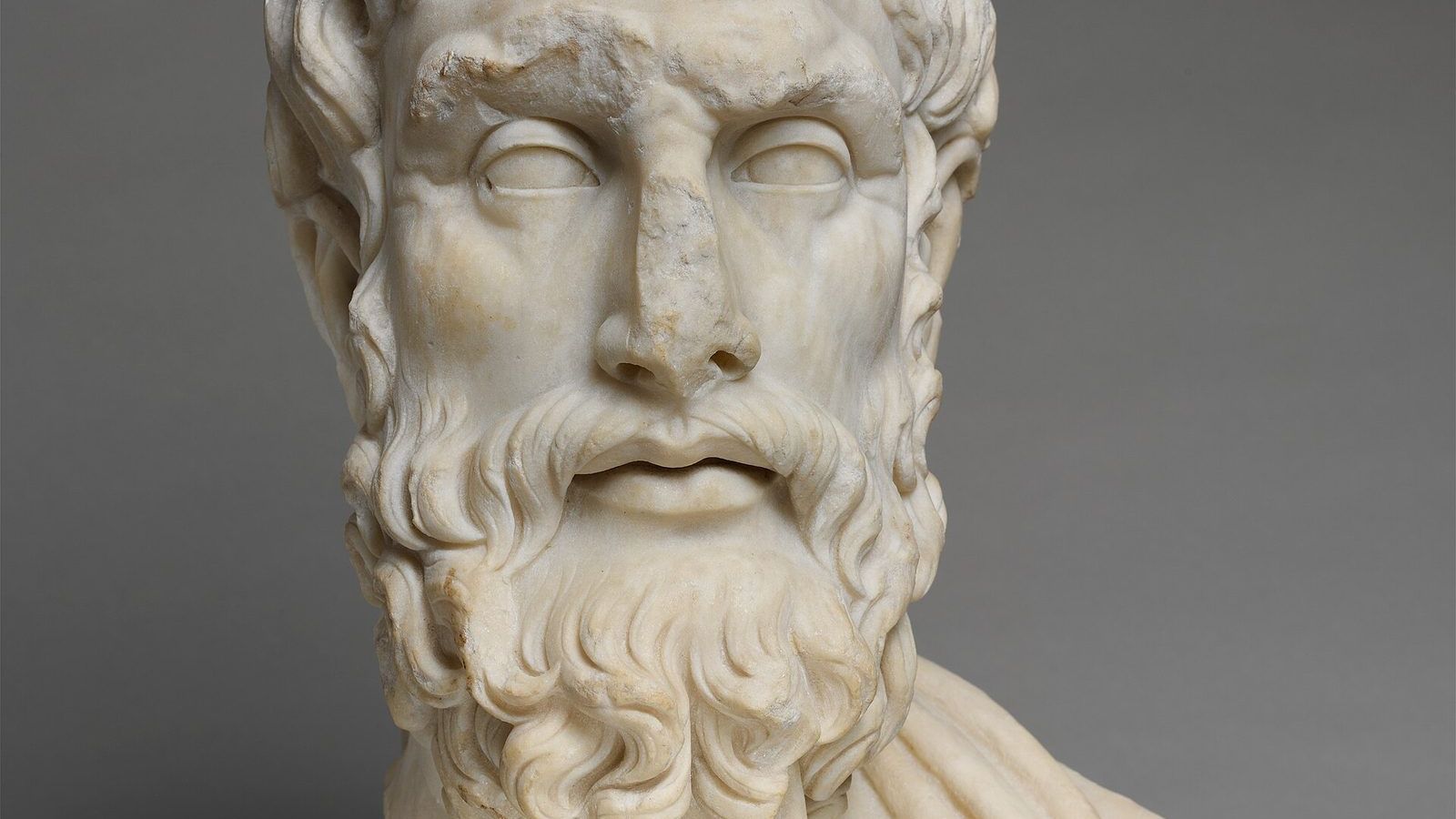
The text is Epicurean in every line. Epicurus had taught that pleasure has a limit, reached when pain and want are removed, and that beyond that limit pleasure can be varied but not increased. The author's point that scarcity adds nothing to the pleasure of food is that doctrine applied. Unit 7 of the masterclass reads the same argument in Epicurus' Letter to Menoeceus and in the Principal Doctrines, where the limit of pleasure is stated as the third of the doctrines.
Since then
The competition continued through 2024 and 2025 with prizes for reading more of the Paris scroll, for making the segmentation automatic, and for finding titles. In 2025 the title of a scroll kept at the Bodleian Library in Oxford, PHerc. 172, was read as the On Vices of Philodemus, the first time the author and title of a closed scroll had been identified from the scan alone. Several hundred scrolls remain unopened in Naples, and a few more in Oxford, Paris, and London. Scanning them all is now a question of money and time rather than of possibility, and the organizers have said that the aim is to read the whole library.
What might be in it is the part of the story that keeps classicists awake. The opened rolls are mostly Greek philosophy, which suggests that the shelves held the working library of an Epicurean teacher. A Roman villa of that size usually had a Latin library too, and that room has not been found; the villa is only partly excavated and most of it still lies under the modern town of Ercolano. Lost works of Aristotle, the missing books of Livy, or a play of Sophocles are not impossible. Nobody should expect them. The texts that are certain to come out are more Philodemus, and Unit 8 of the masterclass, which follows the ancient texts from the Lyceum to the printed page, treats that as the main event: a library of the first century BC read page by page for the first time since the eruption.
How the first word was found
The three steps are worth remembering because they will be repeated on every scroll. The scan produces a three-dimensional image of the whole roll, in which the papyrus is a spiral of thin sheets packed tightly together. Segmentation traces one sheet through that spiral, turn after turn, and flattens it into a strip; most of the human labour of the challenge went into this step. Ink detection then examines the flattened strip and marks the places where the surface shows the cracked texture of dried ink, which the human eye cannot see but a model trained on known examples can. The model is checked against the places where letters are visible on the outside of the roll, so that it is never allowed to invent text. The account of this on the First Letters page is written for a general reader and has the images.