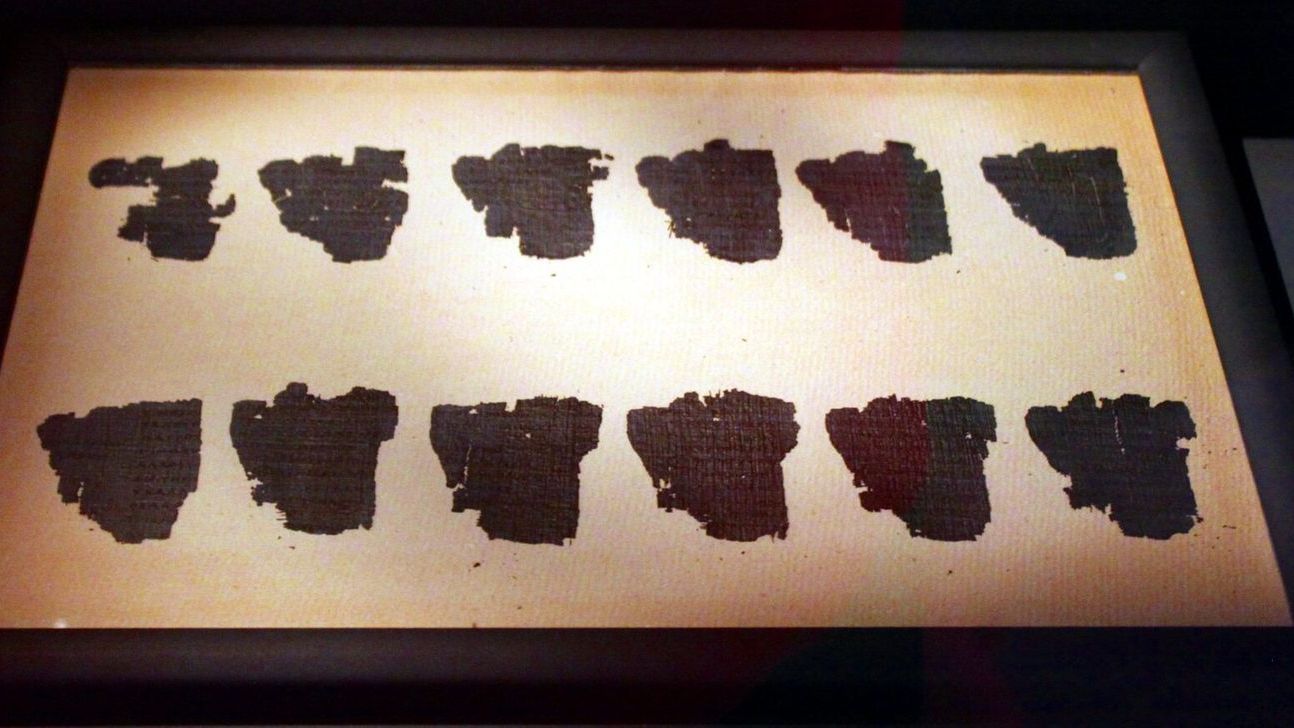
 Image: The Derveni papyrus in the Archaeological Museum of Thessaloniki. Photograph by Fkitselis, CC BY-SA 3.0, via Wikimedia Commons
The Derveni papyrus, the oldest surviving book in Europe
On 15 January 1962, during work on the road from Thessaloniki to Kavala, a group of tombs was uncovered at Derveni, about ten kilometres north of the city. They were the graves of wealthy Macedonians of the late fourth century BC, and one of them held the bronze krater with gilded figures of Dionysus that is now the most famous object in the Thessaloniki museum. On the slab over tomb A, among the remains of the pyre on which the dead man had been cremated, the excavators found a lump of carbonized papyrus. The top of the roll had been burnt away. The lower part, charred black, had been preserved by the same fire, because charred papyrus does not rot.
Opening it
The roll was taken to the museum and opened by Anton Fackelmann, a conservator from Vienna who had worked on the Herculaneum papyri. He used static electricity to lift the layers apart and mounted the pieces between glass. What came out was the lower part of twenty-six columns of Greek, written in a neat hand that the palaeographers date to about 340 to 320 BC. The upper part of every column is gone. The text itself is older than the copy; the commentary it contains was probably composed in the late fifth century BC, in the generation of Socrates. No other Greek manuscript of that age survives anywhere, and because the Herculaneum rolls are later by two or three centuries, the Derveni papyrus is the oldest surviving book from Europe.
The text was known to scholars from a photograph circulated in the 1960s and from an unauthorized transcription printed in 1982, but the full edition, by Theokritos Kouremenos, George Parássoglou, and Kyriakos Tsantsanoglou, did not appear until 2006. In 2015 UNESCO entered the papyrus in its Memory of the World register, where its entry describes it as the oldest surviving book of Europe.
What it says
The roll is a commentary. Its unknown author quotes a poem, line by line, and explains what each line really means. The poem is a theogony, an account of the origin of the gods, attributed to Orpheus: it tells how Zeus swallowed the previous ruler of the world and brought everything forth again from himself. The commentator does not take that literally. He reads every god and every event as a disguised statement about physics. Zeus is air, or mind; the swallowing is the gathering of all things into one; the birth of the gods from Zeus is the separation of the elements out of the mixture. The poem, he says, speaks in riddles, and he is the man who can solve them.
The physics he reads into the poem is that of the Presocratics. The mind that steers everything is Anaxagoras' nous; the air is the air of Diogenes of Apollonia; and in column IV he quotes Heraclitus by name, the sentence about the sun being the width of a human foot and never overstepping its measures, in a form fuller than any other source gives it. That quotation alone would make the papyrus important for Unit 2 of the masterclass, which reads the Presocratics from the fragments that later authors preserved. Here is a quotation of Heraclitus made within a century of his life, by a reader who had the book.
The first columns, before the commentary on the poem begins, deal with ritual: offerings to the Eumenides, the souls of the dead, and what the initiates of the mysteries understand and what they do not. The author seems to have been a religious professional of some kind, a man who performed rites and also held views about the cosmos, and who thought the two went together. That combination surprised scholars when the text became known, because the usual story had the Presocratic physicists replacing religion with explanation. The Derveni author does both at once.
Why a commentary was burnt
Why the roll was on the pyre is not known. Tomb A also held a copy of the krater's kind of luxury: weapons, vessels, the equipment of a Macedonian officer. Perhaps the dead man was an initiate of the Orphic or Dionysiac mysteries and the book was his; perhaps it belonged to the priest who conducted the funeral and was burnt as part of the rite. Gábor Betegh, whose book The Derveni Papyrus: Cosmology, Theology and Interpretation (2004) remains the fullest study, argues that the text makes best sense as the work of someone who wanted to show that the mysteries, correctly understood, taught the same truths as natural philosophy. That would make the roll the earliest surviving example of allegorical reading, the method by which later Greeks read Homer as physics and later still Christians read the Old Testament as prophecy.
The oldest book, and what that means
The phrase oldest book in Europe needs a little care. There are older European writings: inscriptions on stone, the Linear B tablets of the Bronze Age, the painted letters on vases. The Derveni papyrus is the oldest surviving manuscript of a literary text, written on papyrus in a book hand to be read, and it is the oldest by about a century. Older Greek books existed by the thousand. Plato's dialogues, Herodotus' history, and the plays of Sophocles were all in circulation when the Derveni roll was copied. Every one of them survives only in copies made more than a thousand years later. The Derveni papyrus shows what such a book looked like: narrow columns, no spaces between words, no punctuation, no titles, in a hand that an educated reader of the fourth century BC could read at speed.
Unit 1 of the masterclass uses it for that purpose, as the one point in the ancient period where we can see a philosophical book as its first readers saw it. Unit 8 places it on the timeline next to the Herculaneum rolls, the other case of a fire that preserved what it burnt, and notes that both have been read, in part, only in the last decades, the Derveni papyrus by a conservator with static electricity and the Herculaneum rolls by a particle accelerator.
Reading it
The Greek text with an English translation and commentary is the edition of 2006 by Kouremenos, Parássoglou, and Tsantsanoglou, published in Florence; Richard Janko's long review of it in the Bryn Mawr Classical Review is free to read and explains what the edition settled and what it left open, and the same journal's review of Betegh's book is the quickest way into the arguments about who the author was. Read column IV for Heraclitus, and columns XVII to XIX for the commentator at full stretch, explaining that when the poet says Zeus became the first he means that air, which is Zeus, existed before all things were named. The upper lines of each column are missing, and every edition marks the gaps. A reader learns from those gaps as much as from the text: this is what every ancient book looks like before the editors have done their work, and the units of the masterclass that print clean paragraphs of Heraclitus are standing on work of exactly this kind.