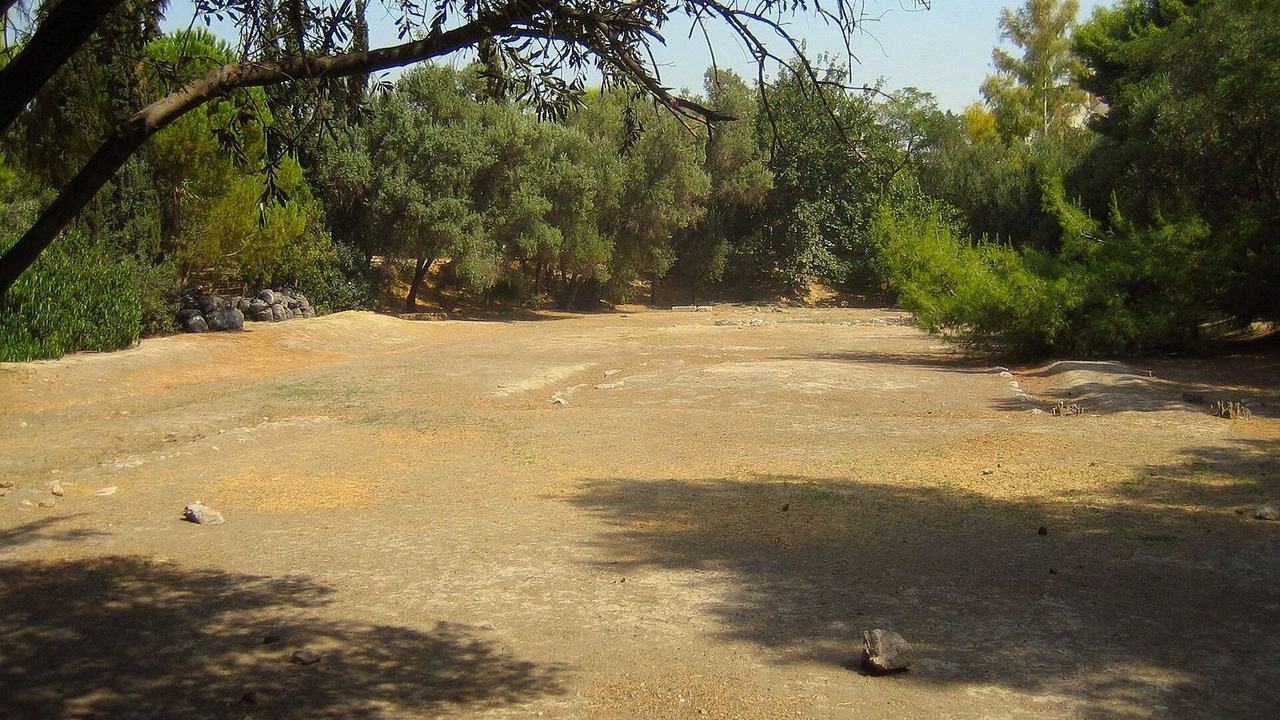
 Image: The archaeological site of Plato's Academy in the Akadimia Platonos district of Athens. Photograph by Tomisti, CC BY-SA 3.0, via Wikimedia Commons
Was Plato's Academy closed in AD 529?
Open almost any short history of philosophy and ancient thought ends on a date: in AD 529 the emperor Justinian closed the Academy at Athens, the school Plato had founded nine centuries earlier, and the philosophers went into exile. The date is right. Nearly everything else in the sentence needs qualifying, and the qualifications are more interesting than the legend.
The one source
The only direct evidence is a sentence in the Chronicle of John Malalas, a Greek writer from Antioch who compiled a history of the world down to his own day in the middle of the sixth century. Under the year 529, in book 18, Malalas reports that during the consulship of Decius the emperor issued a decree and sent it to Athens, ordering that no one should teach philosophy or interpret the laws, and that no one should play at dice. That is the whole of it (Chronicle 18.47). Malalas does not mention the Academy, does not name any philosopher, and bundles the prohibition with a ban on gambling.
Nothing else from the period describes the decree. The law code that Justinian issued in the same years contains general measures against pagans teaching, and the Athenian order was probably an application of them. Whether the ban on teaching law was aimed at the Athenian schools, or whether Malalas has combined two different measures, is not known.
Which school
Plato's Academy, the school he began around 387 BC in a grove outside the walls of Athens, did not survive antiquity as an institution. It passed through several forms, from Plato's own circle to the sceptical Academy of Arcesilaus and Carneades in the third and second centuries BC, and it came to an end in the first century BC: its last head in the old line, Philo of Larissa, left Athens for Rome in 88 BC during the war with Mithridates, and when Sulla besieged the city in 86 BC he cut down the trees of the Academy's grove for his siege engines. After that there were Platonist teachers in Athens, but no continuous school on the old site with a succession of heads.
The philosophers of 529 belonged to a different foundation. Around AD 400 a wealthy Athenian named Plutarch, not the biographer, established a school of Platonic philosophy in the city, teaching the system of Plotinus and Iamblichus that modern scholars call Neoplatonism. His successors included Syrianus, Proclus, who led the school for nearly fifty years and died in 485, and finally Damascius, who was its head in 529. These men called themselves the successors of Plato, and they taught in a house south of the Acropolis, not at the Academy. Their school was about 130 years old when the decree arrived. Calling it the Academy is a modern habit, and a misleading one; Edward Watts, in a study of 2004, showed that the Athenian school had rebuilt its claim to continuity with Plato as a matter of self-presentation, and that the claim had been accepted by later historians rather than examined.
What happened to the philosophers
The historian Agathias, writing in the 570s, tells the next part of the story (Histories 2.30 to 31). Seven philosophers, Damascius of Syria, Simplicius of Cilicia, Eulamius of Phrygia, Priscian of Lydia, Hermias and Diogenes of Phoenicia, and Isidore of Gaza, left the empire for Persia, because they had heard that the Persian king Khosrow was a philosopher on his throne and that his kingdom was ruled justly. They were disappointed in both respects, Agathias says, and asked to go home. When Justinian and Khosrow made peace in 532, the treaty included a clause that the philosophers should be allowed to return and live out their lives in the empire without being forced to change their beliefs.
Where they lived after that is a matter of argument. Simplicius wrote his great commentaries on Aristotle after his return, and Michel Tardieu proposed in the 1980s that he settled at Harran, a city on the Persian frontier where paganism survived, and that a Platonist school continued there for centuries. The evidence is thin and most scholars think the group dispersed; Damascius was in Syria in 538, where an inscription with a poem of his survives. What is certain is that the seven were not executed, not imprisoned, and not silenced: Simplicius' commentary on Aristotle's Physics, one of the main sources for the Presocratics, was written by a man the legend has going into exile for ever.
Did philosophy end
Teaching of Platonic philosophy in Athens did stop, and did not restart. Elsewhere it went on. The school of Alexandria, Christian by this time in most of its staff, continued to teach Aristotle through the sixth century: John Philoponus and Olympiodorus were active there after 529, and the Alexandrian tradition of commentary passed into Syriac and then Arabic. In the Latin West, Boethius had been executed in or about 526 with his translations of Aristotle's logic half finished, and those translations became the whole of Aristotle known in Europe for five hundred years. The masterclass ends its story at 529 because the Athenian succession is a clean stopping point, and Unit 8 says plainly that the phrase the closing of the Academy is a shorthand for a slower and more scattered end.
Why the legend took hold
Edward Gibbon gave the story its modern form in the fortieth chapter of The Decline and Fall of the Roman Empire (1788), where the Athenian schools are the last refuge of Greek reason, extinguished by a Christian emperor. The picture served Gibbon's argument about the Church and the fall of Rome, and it has served many arguments since. Its weakness is that it needs the school of 529 to be Plato's, so that nine centuries of philosophy can end in a single act. The school of 529 was not Plato's, the act was a decree that also banned dice, and the philosophers it affected went on writing.
The Stanford Encyclopedia's articles on Simplicius and on Neoplatonism give the evidence for the journey to Persia and what came after, with the modern discussions. Unit 12 of the masterclass reads Plotinus, from whom the whole Athenian tradition descended, and Unit 8 puts 529 at the end of a timeline that begins with the eclipse of Thales in 585 BC, eleven centuries earlier, with the warning that the end date is a convention agreed for the sake of a story that must stop somewhere.