How did Socrates die? What the Phaedo says and what the doctors found
How did Socrates die? What the Phaedo says and what the doctors found is a small question with a large history. Plato’s Phaedo gives a close account of Socrates’ last hours, and later readers tried to test that scene against modern medical knowledge. The result is a debate about texts, symptoms, and how far a philosophical dialogue can be read like a medical report.
Plato’s account in the Phaedo
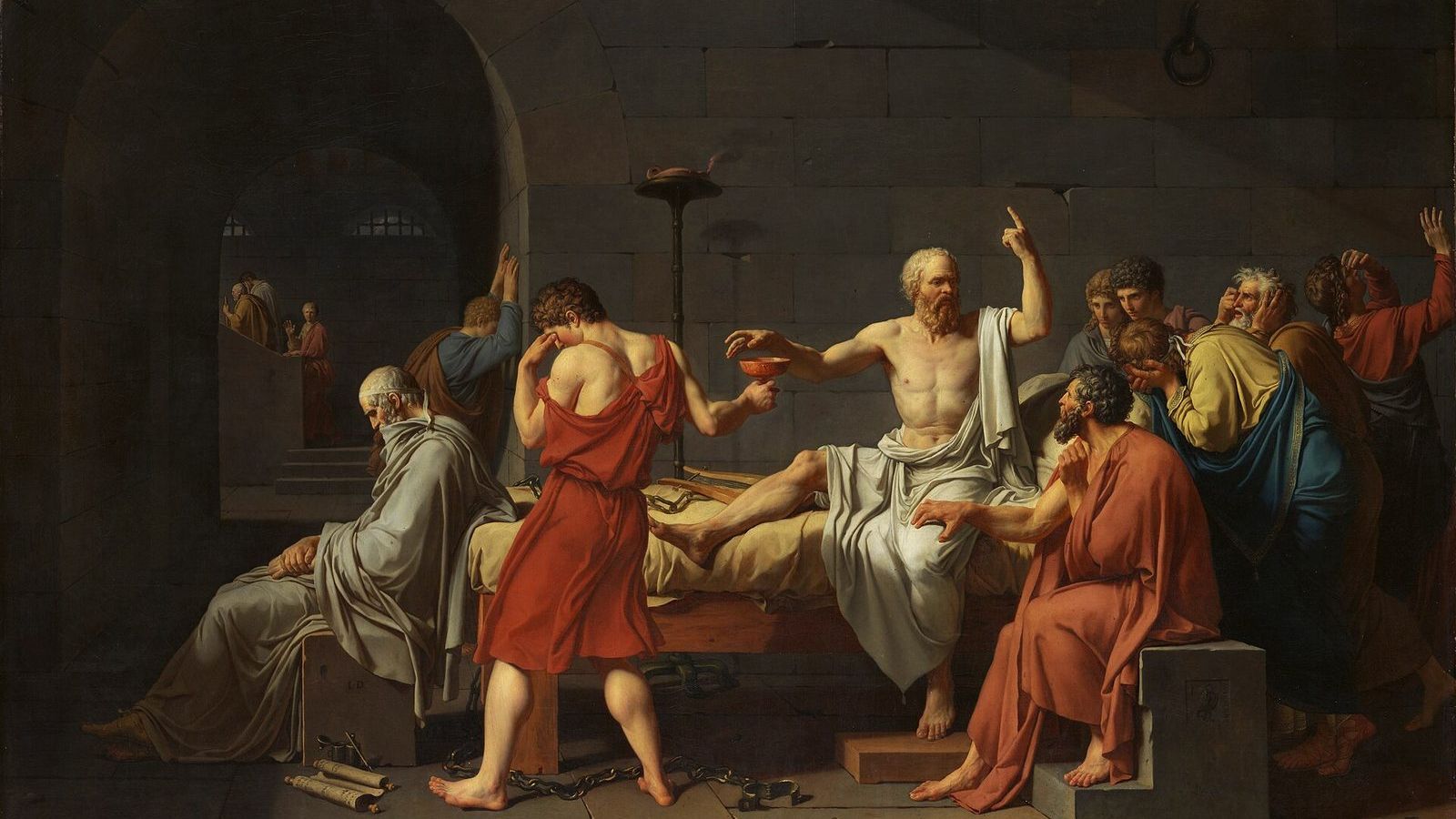
Plato places Socrates’ death at the end of the Phaedo, during the dialogue set on the day of his execution in 399 BCE. At 117e to 118a, the jailer tells Socrates to walk about until his legs feel heavy after drinking the poison. Socrates then lies down, the cold rises from his feet, and the numbness moves upward through his body until it reaches his chest. Plato has Socrates cover himself, speak a few last words about a sacrifice to Asclepius, and then die.
The scene is brief, controlled, and strikingly physical. Plato does not describe convulsions, violent retching, or the kind of dramatic suffering that later readers might expect from a poison death. Instead, the body seems to shut down in a clear sequence: legs first, then the lower body, then breathing.
This matters because the passage is one of the few ancient accounts of a death that has invited clinical scrutiny. A philosophical text has become evidence for toxicology.
Why some twentieth-century doctors doubted hemlock
In the twentieth century, some physicians and medical writers questioned whether the poison in the Phaedo could really have been poison hemlock, usually identified with Conium maculatum. The doubt came from the mismatch they thought they saw between Plato’s description and modern expectations about poisoning. In many poisonings, the body produces clear spasms, vomiting, seizures, or rapid collapse. Plato’s Socrates remains lucid and calm almost to the end.
Those doubts were serious enough to keep the question alive in both classics and medicine. If the scene does not sound like the effect of hemlock, then what was the drug, and how literal is Plato being? Some readers treated the passage as literary composition with only loose contact with real execution practice. Others thought the ancients may have used a different mixture, or a preparation that worked more slowly than later cases of hemlock poisoning known to doctors.
The main point is simple. The twentieth-century challenge was not that Plato’s text is unreliable in every detail. It was that the symptom pattern looked, to some doctors, unlike the poison hemlock they knew from modern medicine.
How did Socrates die? What the Phaedo says and what the doctors found
Enid Bloch gave the most influential reply. In her reading, the ancient evidence does fit poison hemlock, once the symptoms are compared carefully and the medical assumptions are kept modest. Bloch argued that the death described by Plato matches the known effects of hemlock poisoning better than the sceptics allowed.
Her case rests on the order of the symptoms. In the Phaedo, the poison seems to begin with weakness in the legs, then travel upward in a gradual loss of sensation and control. That fits a poison that can cause progressive paralysis and respiratory failure. Socrates stays composed, which also suits a slow-acting toxin rather than a violent irritant. Bloch therefore treated the text as evidence for Conium maculatum without assuming that every detail in Plato is clinical shorthand.
Her reading is careful rather than sensational. She does not claim that Plato wrote a modern autopsy report. She argues that, given what the text says, hemlock remains the best fit. That is an important distinction. Ancient texts can preserve enough detail to be checked, while still remaining literary works shaped by authorial choice.
Why hemlock is still the best-known answer
One reason the hemlock explanation remains strong is that ancient sources repeatedly connect Socrates’ execution with a state poison administered by officials, and the Phaedo gives a sequence that looks like progressive neuromuscular failure. Another reason is historical context. Athens used the drug for executions, and the story that Socrates was given a cup of poison is thoroughly established in the tradition.
Still, caution is necessary. No modern reader can identify the exact plant sample, dose, or preparation used in 399 BCE. The evidence is indirect. What the medical debate shows is that the old story is detailed enough to provoke genuine disagreement, and detailed enough to support a serious reply. That is why Bloch’s article matters. It brings philology and medicine into the same conversation.
For students, this is a good example of how ancient philosophy can be studied through close reading. A few lines at the end of a dialogue can generate a historical puzzle, a medical dispute, and a question about how much a literary text can tell us about real events.
For more on Plato and Socrates, see our Socrates and Plato topic page, Plato's cave, divided line, and sun explained together, and Did Socrates say I know that I know nothing?. The best unit for this topic is Plato's Forms and the Soul.
Sources
- Stanford Encyclopedia of Philosophy, Socrates
- JSTOR search for Enid Bloch on the death of Socrates
- University of Oxford, humanities research context
Frequently asked questions
Did Socrates really drink hemlock?
That is the standard ancient account, and Plato’s Phaedo describes the poison in detail. Later medical readers debated whether the symptoms fit hemlock, and Bloch argued that they do.
Why did doctors doubt the story?
Some twentieth-century doctors thought Plato’s symptoms looked too calm and too orderly for hemlock poisoning as they understood it. The debate turned on how closely one should match an ancient literary scene to modern toxicology.
Is Plato’s account only literary?
No one should treat it as a hospital record, but it is also more than a symbolic ending. The text contains enough physical detail that historians and physicians have continued to test it against real poison effects.
This topic fits the masterclass unit on Plato's Forms and the Soul, where close reading and argument both matter.