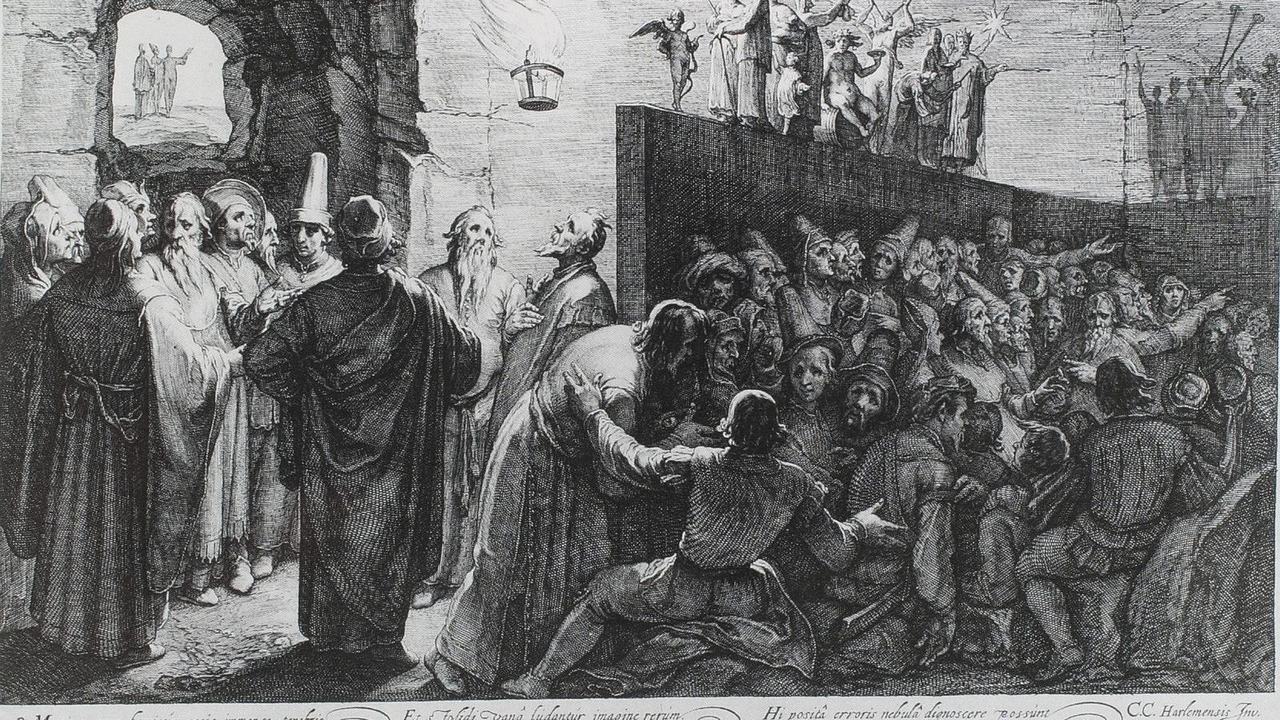
 Image: Jan Saenredam after Cornelis van Haarlem, Plato's Cave, engraving of 1604, public domain, via Wikimedia Commons
Plato's cave, divided line, and sun explained together
The cave is the most famous passage in Plato, and it is usually read on its own. In the Republic it is the third of three images that come one after another at the end of book VI and the start of book VII, and Socrates says explicitly that the third is to be fitted to the first two (517b). Read together, the sun, the line, and the cave are one argument about what there is, how we know it, and why a person who has seen it would have to be forced to go back and govern. The page numbers below are the Stephanus pages that every edition prints in the margin.
The sun (507b to 509c)
Glaucon has asked Socrates to say what the Good is. Socrates refuses, saying it is beyond him, and offers instead what he calls the offspring of the Good, an image. In the visible world, he says, there are many beautiful things and one Form of the Beautiful, many good things and one Form of the Good; the many are seen and not thought, the Forms are thought and not seen. Sight needs a third thing besides the eye and the object: light, and the source of light is the sun. The sun is not sight, but it is the cause of sight and is itself seen by it. So it is, Socrates says, with the Good in the intelligible world. The Good is to the mind and to the things it knows what the sun is to the eye and to the things it sees: it gives them truth and gives the mind the power of knowing. And as the sun also makes things grow, the Good gives the objects of knowledge their very being, while itself being beyond being in dignity and power (509b).
That last sentence has produced more commentary than any other in Plato, and Unit 4 of the masterclass takes it slowly. For the present purpose the image fixes three levels: the sun, the things it lights, and the eye that sees them; and on the other side the Good, the Forms, and the mind that knows them.
The line (509d to 511e)
Socrates now asks Glaucon to picture a line cut into two unequal parts, the visible and the intelligible, and each part cut again in the same ratio. The lowest section is images: shadows and reflections. Above it are the things that cast them: animals, plants, artefacts. Those two make up the visible. In the intelligible, the lower section is what mathematicians study: they use visible diagrams but reason about the square itself, and they start from assumptions they do not examine. The highest section is what dialectic reaches: starting from assumptions, it goes up to a first principle that needs no assumption, and comes down again using only Forms. Socrates names four conditions of the soul to match the four sections (511d to e): eikasia, imagining, for images; pistis, belief, for visible things; dianoia, thought, for the mathematical; and noēsis, understanding, for the Forms. Each is clearer than the one below in the same proportion as its objects have more truth.
The ratios are the point of the line, and they produce one oddity that commentators have enjoyed since antiquity. If the whole line is cut in a ratio and each part is cut in the same ratio, the second and third sections turn out to be equal in length, although the third is supposed to be clearer than the second. Plato does not mention it. Whether he noticed is one of the small questions that Unit 4 leaves open.
The cave (514a to 517a)
Then the picture. Prisoners sit chained in an underground cave, facing the back wall, unable to turn their heads. Behind them a fire burns, and between the fire and the prisoners runs a road with a low wall, along which people carry statues and figures of animals, so that the shadows of the figures fall on the wall the prisoners face. The prisoners have never seen anything but the shadows, and they take the shadows for the things themselves. One is released and made to turn round; the fire hurts his eyes, and the figures look less real to him than the shadows he knew. He is dragged up the rough passage into the daylight, where at first he can see only shadows and reflections, then objects, then the stars at night, and finally the sun. He understands that the sun governs everything in the visible world. He pities the prisoners. If he went back down, his eyes would fail in the dark, the others would laugh at him and say that the ascent had ruined his sight, and if he tried to free them they would kill him (517a).
Plato's own key (517b to c)
Socrates then says how the image fits. The cave is the visible region. The light of the fire in it is the power of the sun. The ascent and the sight of things above are the soul's rise into the intelligible region. And the last thing to be seen, with difficulty, is the Form of the Good, which once seen is understood to be the cause of everything right and beautiful, giving birth in the visible world to light and the sun, and in the intelligible world being itself the source of truth and understanding. Anyone who is to act wisely must have seen it.
Lay the three images side by side and the levels line up. The shadows on the wall are the images of the lowest section of the line, seen by imagining. The figures carried along the road are visible things, known by belief. The reflections and shadows outside the cave are the mathematical objects, known by thought. The things themselves and the stars are the Forms, known by understanding. The sun is the Good. The fire in the cave is the visible sun, which lights the visible world but is itself only an offspring of the Good. The prisoner's ascent is education, which Socrates defines at 518c not as putting sight into blind eyes but as turning the whole soul round so that the eye it already has looks in the right direction.
What the fit explains
Two things that puzzle readers of the cave alone become clear once it is fitted. The first is why the released prisoner must go back. The sun image has already said that the Good is the cause of everything right; the line has said that dialectic comes down again from the first principle to the Forms. A person who has seen the Good is the only one who can govern well, and the city that educated him has a claim on him (519c to 520e). Plato does not pretend that he will want to. The second is what the shadows are. Readers often take them for ordinary sense perception. On the line they are the lowest section, below the visible things themselves, and in book X Plato gives the examples: paintings, poems, the images of things made by people who do not know the things. The prisoners of the cave are not people who use their eyes. They are people who have never used them, because they have taken what others showed them for the world.
The passages are on the Perseus Digital Library in Greek and in Paul Shorey's translation; start at 507b and read through to 518c in one sitting, which takes about forty minutes. Unit 4 of the masterclass does the same with a drawing of the three images on one page, and then asks the question that Glaucon does not ask: whether the Good that is beyond being can be the object of knowledge at all, and what Plato thought he was doing by putting an image where an argument should be.