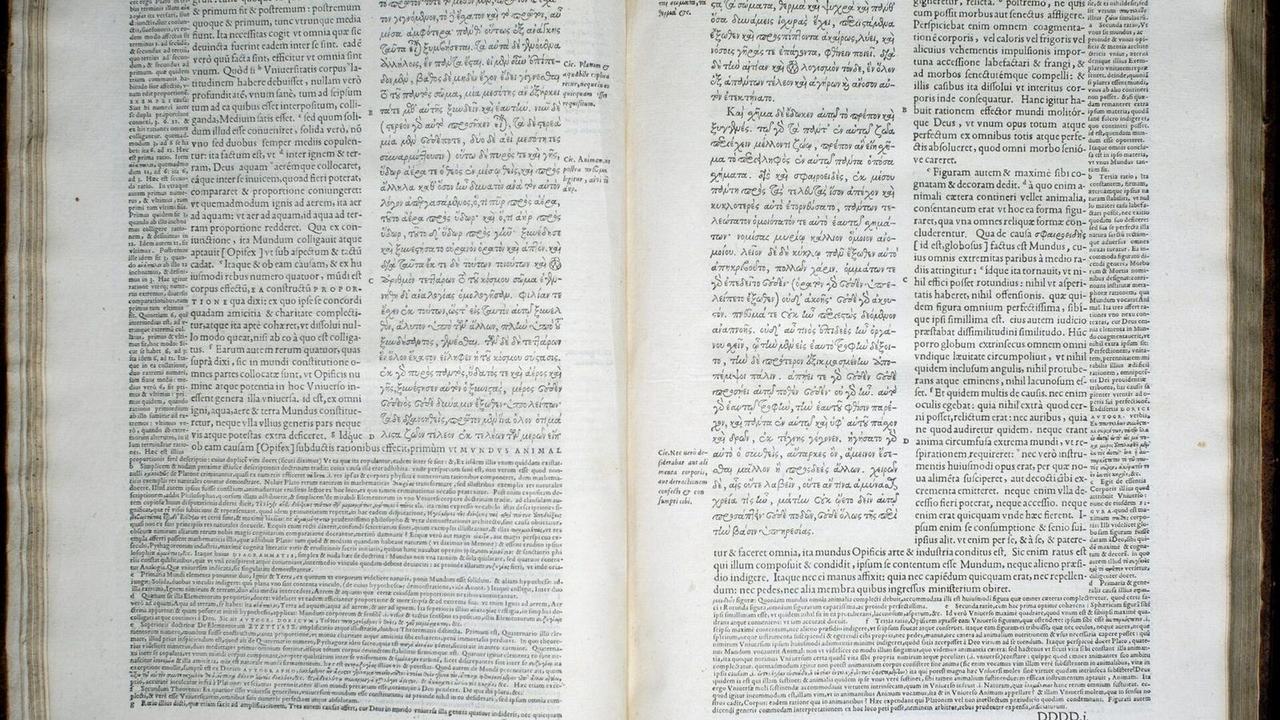
 Image: Two pages of the Timaeus in Henri Estienne's edition of Plato, Geneva 1578, public domain, via Wikimedia Commons
What does Republic 514a mean? Stephanus pages explained
Open any translation of Plato's Republic, in any language, and look for the start of the allegory of the cave. In the margin you will find 514a. Open a different translation and the same number stands beside the same sentence. Search for it on the Perseus Digital Library and the Greek text appears at the same place. The number is not a page of the book in your hand; it is a page of a book printed in Geneva in 1578, and the whole field of ancient philosophy has agreed to use it as an address.
The edition of 1578
Henri Estienne, known by the Latin form of his name as Henricus Stephanus, was the son of the Paris printer Robert Estienne and the most learned Greek scholar among the printers of his century. In 1578 he published Platonis opera quae extant omnia, the complete surviving works of Plato, in three large volumes. Each page carries the Greek text in one column and a new Latin translation by Jean de Serres (Serranus) in the other. Down the margin between them, Estienne printed the letters a, b, c, d, and e at roughly equal intervals, dividing the page into five parts so that a reader could refer to a passage by page and letter and the other reader could find it in a moment.
That was a printer's convenience, not a scholarly system. It became a system because the edition was good enough and widespread enough that the scholars of the next two centuries cited it, and because when Immanuel Bekker published his own edition of Plato in Berlin from 1816, he printed Estienne's page numbers and letters in his margin so that the old citations would still work. Every later editor did the same. John Burnet's Oxford text of 1900 to 1907, which is still the standard Greek, has them; so do the Loeb volumes, the Hackett translations, and the Penguin ones.
How to read an address
A citation such as Republic 514a has three parts. The title identifies the dialogue, because Estienne's page numbers start again in each of his three volumes and the same number occurs in several works: there is a 514a in the Republic and another in the Gorgias. The number is the page of the 1578 edition on which the passage stood. The letter is the fifth of that page in which it stood. A range is written with a hyphen, as in Phaedo 72e-77a, and runs across pages as the text does.
Because Estienne's pages were large and the letters divide them only into fifths, one letter section can hold eight or ten lines of Greek. When two sentences in the same section must be told apart, editors add a line number counted within the section: Apology 21d1 is the first line of section d of page 21. You will rarely need the line numbers unless you are reading commentaries. The masterclass uses page and letter throughout and adds line numbers only where two sentences on the same section are discussed together.
The Republic and the Laws have an older division into books, and a citation may carry the book as a Roman numeral before the page, as in Republic VII 514a. The book number is redundant, since 514a can only be in book VII, but it tells you where you are in the argument.
Why the numbers do not match your translation
Greek and English take different amounts of space, and a translator's paragraph never ends exactly where Estienne's letter section ended. So the marginal letters in a translation are placed approximately, against the sentence where the translator judges the section begins. A quotation cited as 514a may begin a line or two before or after the letter in your copy. This is normal and no cause for alarm. Where precision matters, the Greek is the reference and the translation follows it.
A second oddity: the numbers run in Estienne's order of the dialogues, not in any order of reading. The Euthyphro begins on page 2, the Apology on page 17, the Republic on page 327 of the second volume, and the Laws on page 624 of the second volume. Nobody reads Plato in that order, and nobody needs to. The numbers are addresses, not a route.
The same idea for Aristotle
Aristotle has a system of the same kind built on a different book. Immanuel Bekker's edition of Aristotle for the Berlin Academy in 1831 printed the works in two columns on each page, and a passage is cited by Bekker's page, the column (a or b), and the line: Nicomachean Ethics 1094a1 is the first line of the left column of page 1094, the opening sentence of the work. Because Bekker's lines are narrow, the line numbers are precise and are always given. Aristotle's works run continuously through the two volumes, so a Bekker number identifies the work without a title: anything in the 1094 to 1181 range is the Nicomachean Ethics. Unit 1 of the masterclass explains both systems once, with pictures of the two pages, and after that every unit cites by them without comment.
Seeing the book
Copies of Estienne's edition survive in many libraries, and the Internet Archive has a complete scan of the first volume from the John Adams Library in Boston, where you can see the two columns, the marginal letters, and the Latin facing the Greek: Platonis opera quae extant omnia, volume 1. Look at any page and you will see how approximate the letters are: they sit at equal distances down the margin regardless of where the sentences break.
The Perseus Digital Library at Tufts University lets you type a Stephanus address into a box above the text and jump to it, in Greek or in English. The start of the cave is at Republic 514a. Try it with any address from a unit and you have the original in front of you within a few seconds.
Why it matters
The system is a small thing, and it is the reason the subject works. A scholar in Tokyo, a teacher in Lagos, and a student in Warsaw can argue about one sentence of Plato without owning the same book, because all three can find it. When a unit of the masterclass quotes Apology 38a and says that Socrates calls the unexamined life not worth living for a human being, the address is an invitation to check: open the text, find 38a, and read the sentence in its context. Every quotation in the program carries one for that reason. A famous line without an address is a line you cannot check, and a good many famous lines of Socrates turn out, when checked, not to be there.