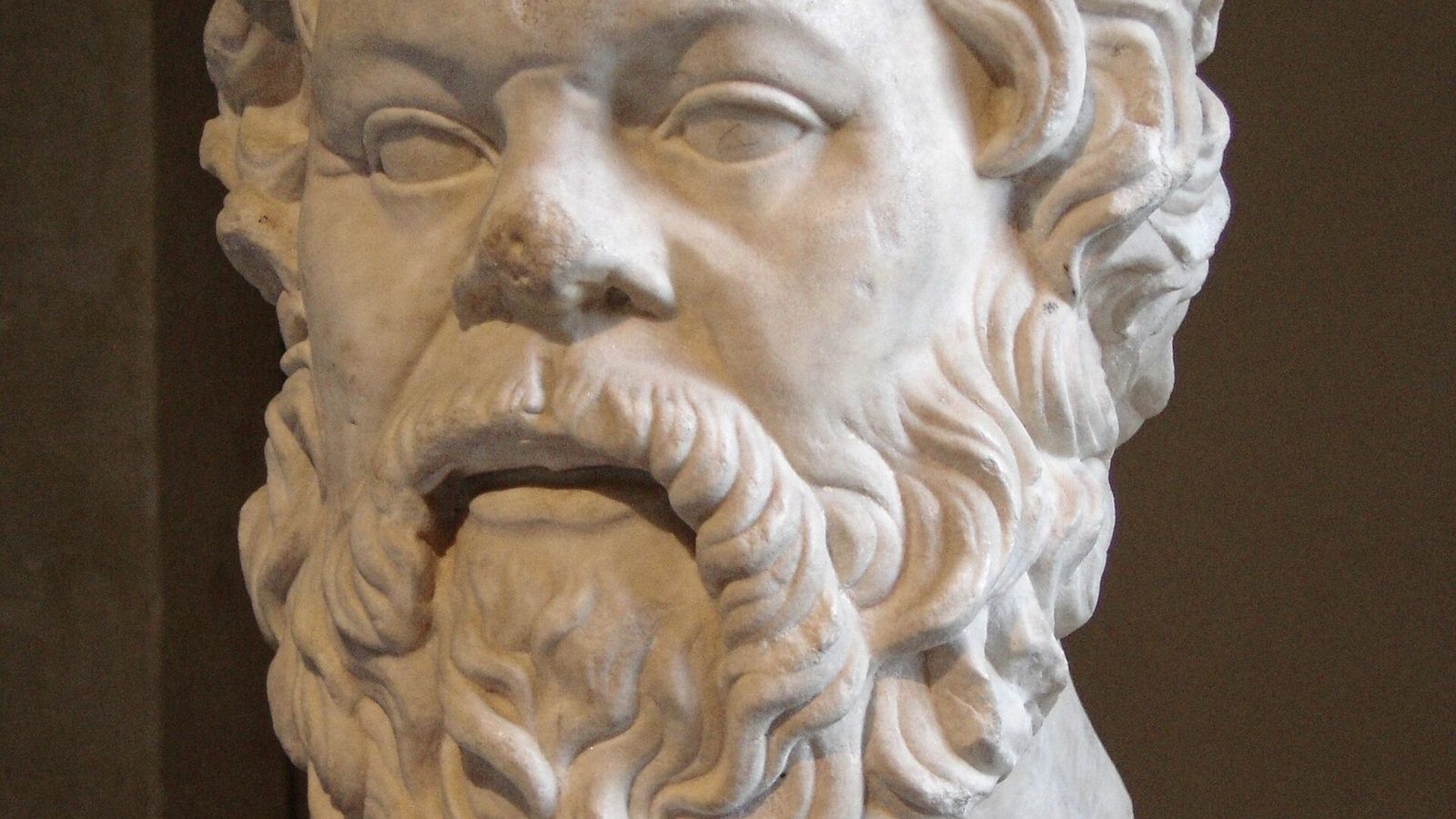
 Image: Portrait of Socrates, Roman marble of the first century AD after a Greek original, Louvre, public domain, via Wikimedia Commons
Did Socrates say I know that I know nothing?
Type the words into a search engine and you will find them on posters, mugs, and the first slide of a thousand lectures: I know that I know nothing. Attributed to Socrates. The trouble is that no text of Plato, Xenophon, or any other contemporary has Socrates say it, and the sentence as usually quoted contradicts itself, since knowing that one knows nothing is knowing something. What Socrates does say is worth more.
The passage people are thinking of
The source is Plato's Apology, the speech Socrates gives at his trial in 399 BC. Socrates tells the jury that his friend Chaerephon once asked the oracle at Delphi whether anyone was wiser than Socrates, and the oracle answered that no one was. Socrates, who did not think himself wise, set out to test the oracle by questioning men with a reputation for wisdom. The first was a politician. After the conversation, Socrates says (Apology 21d, in our own translation): I am wiser than this man. It is likely that neither of us knows anything fine and good, but he thinks he knows something when he does not, whereas I, since I do not know, do not think that I do either. So I seem to be wiser than he in just this small thing, that what I do not know I do not think I know.
Read it slowly. Socrates does not say that he knows nothing. He says that he does not know anything fine and good, kalon kagathon, which in his mouth means the things that matter for living well: what virtue is, what justice is, how a person should live. And he does not claim to know even that; he says it is likely. His advantage over the politician is not a piece of knowledge but the absence of a false belief.
The second passage is 23a to b, where Socrates draws the lesson of the whole enquiry. The oracle, he concludes, meant that human wisdom is worth little or nothing, and that the wisest human is the one who, like Socrates, has recognized that in respect of wisdom he is in truth worth nothing. Again the claim is about wisdom in the full sense, and again it is a recognition, not a boast.
Where the slogan came from
The compressed form has a long history of its own. Diogenes Laertius, writing in the third century AD, reports in his life of Socrates (2.32) that Socrates used to say he knew nothing except just this, that he knew nothing. Cicero, in the Academica (1.16), has Socrates say in all his conversations that he knows nothing except that he knows nothing, and uses him as the ancestor of the sceptical Academy. The Latin tag scio me nihil scire grew out of these later reports and was carried into every European language. By the time it reached the poster it had lost both its qualification and its irony.
Diogenes and Cicero were not inventing from nothing. Socrates in Plato often says that he does not know the answer to the question under discussion, and he says it so regularly that his opponents accuse him of pretending. Thrasymachus in the Republic (337a) calls it his usual irony. The slogan is a flattening of a real habit. What it flattens is the difference between not knowing what virtue is and knowing nothing at all.
What Socrates said he knew
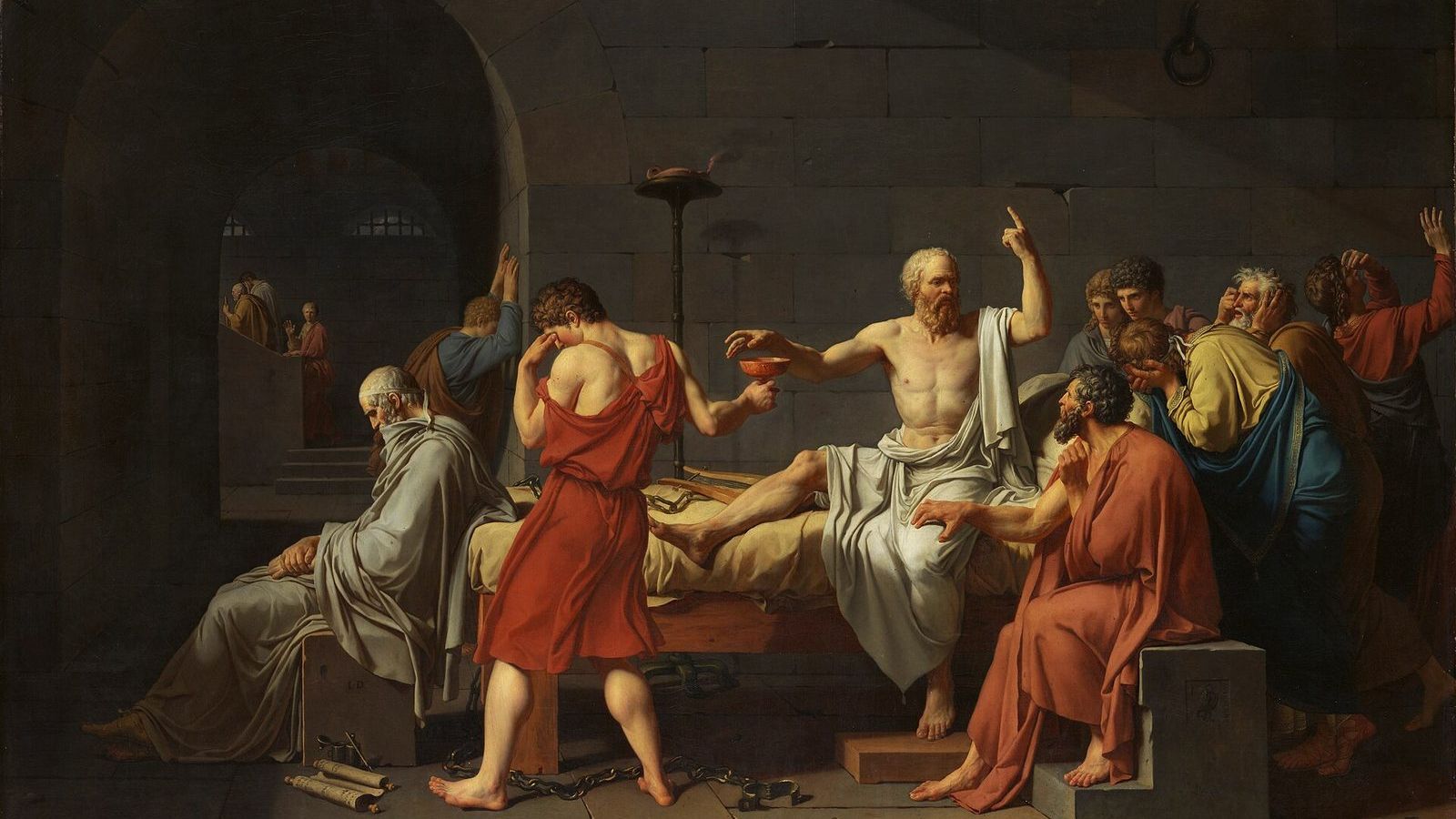
The Apology itself shows that Socrates claimed knowledge of some things and was prepared to die for them. At 29b he tells the jury that he does not know whether death is good or bad, and will not fear what he does not know; but, he goes on, I do know that to do wrong and to disobey one's superior, whether god or man, is bad and shameful. That is a claim to moral knowledge, stated with the verb to know, in the same speech. At 37b he says that he knows well that going to prison or into exile would be an evil for him. Whatever Socrates' ignorance was, it did not cover the difference between right and wrong.
Scholars have spent a good deal of effort on reconciling these claims with the disavowals, and the masterclass sets out the main lines in Unit 3. One reading, developed by Gregory Vlastos in a paper of 1985, distinguishes two senses of knowing: certain knowledge, which Socrates disclaims, and the kind of knowledge that has survived cross-examination, which he is willing to assert. Another reading takes the disavowals at face value and treats the moral claims as very strong beliefs. A third, going back to the ancient Academy, makes Socrates a sceptic in earnest. The text does not settle it, which is why the question is still open.
Two other sentences that are not his
Two more lines usually attached to Socrates deserve the same treatment. Know yourself, gnōthi sauton, was inscribed at the temple of Apollo at Delphi, and Socrates quotes it at Phaedrus 229e and in Xenophon's Memorabilia 4.2.24 as something everyone knew. He took it seriously. He did not say it first.
The unexamined life is not worth living is his, with an address: Apology 38a. The full sentence is longer and the last words matter: the unexamined life is not worth living for a human being, anthrōpōi. Socrates is not making a general remark about lives; he is explaining to the jury why he will not promise to stop questioning people in exchange for his life, because a human life without that examination is not one he would call living. Quoted in full it is a claim about what a human being is for. Quoted short it is a slogan, and slogans were exactly what Socrates spent his days taking apart.
How to check a quotation
The habit the masterclass tries to build is a simple one. When a sentence is attributed to an ancient philosopher, ask for its address: the dialogue and the Stephanus page for Plato, the Bekker number for Aristotle, the book and section for Diogenes Laertius. If none is offered, be suspicious. If one is offered, open the text and read the sentence in its paragraph. The Apology is on the Perseus Digital Library in Greek and English, and 21d is a few seconds away. The Stanford Encyclopedia of Philosophy's article on Socrates has a careful section on his profession of ignorance and the ways it has been read.
The sentence Socrates actually said at 21d is harder to put on a mug. It is also a better description of a thinking person: not someone who knows nothing, but someone who has noticed which of their beliefs they cannot defend, and has stopped pretending otherwise.