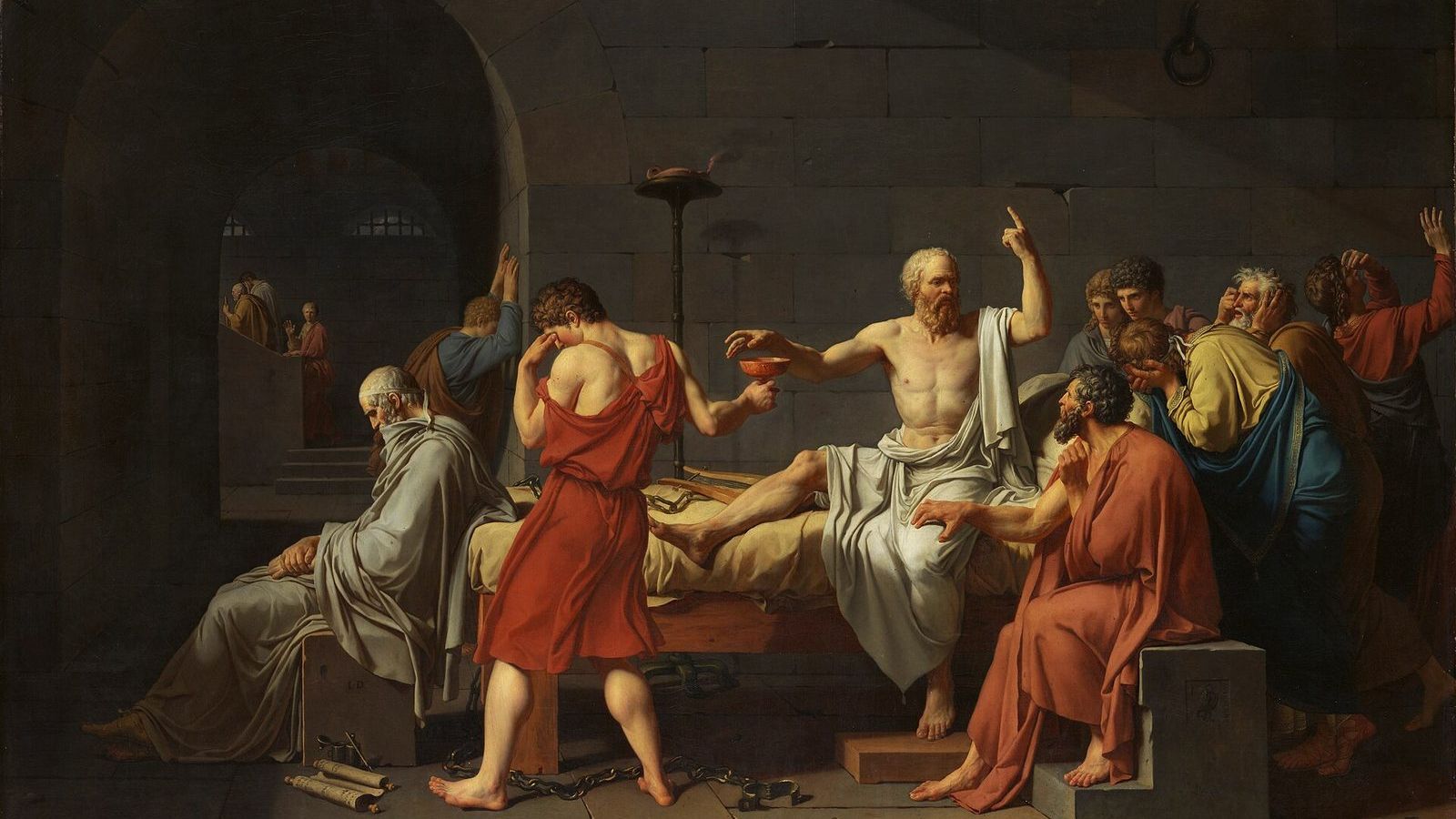
 Image: Jacques-Louis David, The Death of Socrates (1787), Metropolitan Museum of Art, public domain, via Wikimedia Commons
How did Socrates die? The Phaedo and the hemlock evidence
Socrates was executed in Athens in the spring of 399 BC, some weeks after a jury of about 500 citizens found him guilty of not acknowledging the city's gods and of corrupting the young. The method was a cup of hemlock. Plato was not in the room, as he tells us himself at Phaedo 59b, where Phaedo lists those present and adds that Plato, he thinks, was ill. What we have is Plato's report of what Phaedo told a group in Phlius some time later, and it is the only full account of the death that survives. Xenophon, the other witness to Socrates' life, was away in Asia in 399 and says almost nothing about the final hours.
What the Phaedo describes
The description is short and comes at the very end of the dialogue, at 117e to 118a. Socrates takes the cup from the jailer, asks whether he may pour a libation from it, is told the dose is measured exactly, and drinks it off. His friends weep and he scolds them for it. He walks about, as the man who brought the poison has told him to, until his legs grow heavy, and then lies down on his back. The man presses his foot and asks whether he feels it; he says no. The same at the shins. The jailer shows the others that Socrates is growing cold and stiff from the feet up, and says that when the cold reaches the heart he will be gone. When it reaches the lower belly Socrates uncovers his face and says the last sentence Plato gives him: Crito, we owe a cock to Asclepius; pay it and do not forget. Crito says it will be done and asks whether there is anything else. There is no answer. A little later he stirs, the man uncovers him, and his eyes are fixed. Crito closes his mouth and eyes.
Three things stand out in that passage. The paralysis moves upward from the feet. Socrates stays able to speak and think until near the end. And nothing violent happens: no convulsions, no vomiting, no cries. The Greek word for the poison, kōneion, is the ordinary name of hemlock, and the method was the city's standard one for a citizen condemned to death.
Why doctors doubted it
From the nineteenth century on, physicians who read the passage compared it with what they knew of hemlock poisoning and found it too tidy. Medical handbooks described convulsions, retching, salivation, and a struggle for breath. On that basis several scholars in the twentieth century concluded that Plato had cleaned up the death to fit the dialogue: the philosopher who has argued all afternoon that the soul is immortal dies as calmly as he spoke, and the ugly facts were left out. Some went further and suggested that the drink was a mixture, perhaps hemlock with opium, which would explain the quiet.
The doubt was reasonable as far as it went. It rested on a confusion about plants that was not cleared up until the evidence was examined by someone who knew both the texts and the botany.
Which hemlock
Two plants share the English name. Poison hemlock, Conium maculatum, is a tall plant of the carrot family with purple-spotted stems, common across the Mediterranean and in Attica. Its active alkaloid is coniine, which blocks the junction between nerve and muscle. Its effect is an ascending paralysis: the feet and legs go first, then the trunk, then the muscles of breathing. The mind stays clear until oxygen fails. Water hemlock, Cicuta, is a different genus; its toxin, cicutoxin, attacks the central nervous system and causes exactly the violent seizures the handbooks described. Water hemlock does not grow in Greece. The handbooks had, in effect, described the wrong plant.
Enid Bloch, in a study first published in 2001 and reprinted in Thomas Brickhouse and Nicholas Smith's collection The Trial and Execution of Socrates (2002), went through the medical literature on coniine case by case, including the nineteenth-century reports of accidental poisonings in which the patients remained conscious while paralysis climbed their bodies. Her conclusion was that Plato's description matches poison hemlock point for point: the walking about to speed the absorption, the heaviness in the legs, the loss of feeling tested from the feet upward, the cold, the clear speech until near the end, and death by failure of the breathing muscles. On that reading the Phaedo is a good clinical description, and the charge that Plato invented a peaceful death falls.
Ancient sources support the identification. The Greek pharmacologists knew kōneion as a plant that cooled the body and killed by paralysis, and Nicander's poem on poisons in the second century BC describes the victim's legs failing. Theophrastus, Aristotle's successor, reports at Inquiry into Plants 9.16.8 that a man of Ceos named Thrasyas had found a way to prepare the drug so that death came easily and painlessly, which suggests the Athenians knew what they were doing when they chose it.
What Plato left out
None of this means that the Phaedo is a transcript. Plato was not there. He chose what to report and what to leave in silence, and a death by coniine would in fact have included things he does not mention: the face can turn grey, the pupils dilate, and the breathing becomes laboured before it stops. Socrates covers his face at 118a, and the text does not say why. A reader is free to think that Plato spared us something. The point of Bloch's work is narrower and firmer: what Plato does describe is possible, and the version in the medical handbooks was not.
There is a second reason to trust the passage. The Phaedo was written for people who had known Socrates and some of whom had been in the prison. Crito, Phaedo, Apollodorus, Cebes, and Simmias are all named as present. A description that falsified the manner of death in front of living witnesses would have been a strange risk for an author whose purpose was to show that Socrates had lived and died as he taught.
The cock for Asclepius
The last words have been read in more ways than any other sentence of Plato. Asclepius was the god of healing, and a cock was the ordinary thank-offering after a cure. The oldest reading, and still the most common, is that Socrates treats death as a cure for the disease of life, which fits the dialogue's argument that the philosopher spends his life preparing to die. Others have taken it as a plain religious duty remembered at the last minute, and Glenn Most argued in 1993 that the debt was for Plato's recovery from the illness mentioned at 59b. The text does not settle it, and the units of the masterclass that read the Phaedo set out the options rather than choose.
Reading the passage yourself
The Greek with an English translation is on the Perseus Digital Library, where you can jump to 117e and follow the last page in both languages. The address system is the one the whole field uses: the numbers are pages of the 1578 edition of Henri Estienne and the letters divide each page into five parts. A reader who wants the wider picture of the trial will find it in the Stanford Encyclopedia of Philosophy's article on Socrates, which also discusses how far Plato's Socrates can be taken as the historical man.
Unit 3 of the masterclass follows the trial through the Apology to the verdict and the margin of votes, and Unit 4 reads the arguments for the soul's immortality that fill the hours before the cup is brought. The death itself takes a page. It is the page most readers remember.