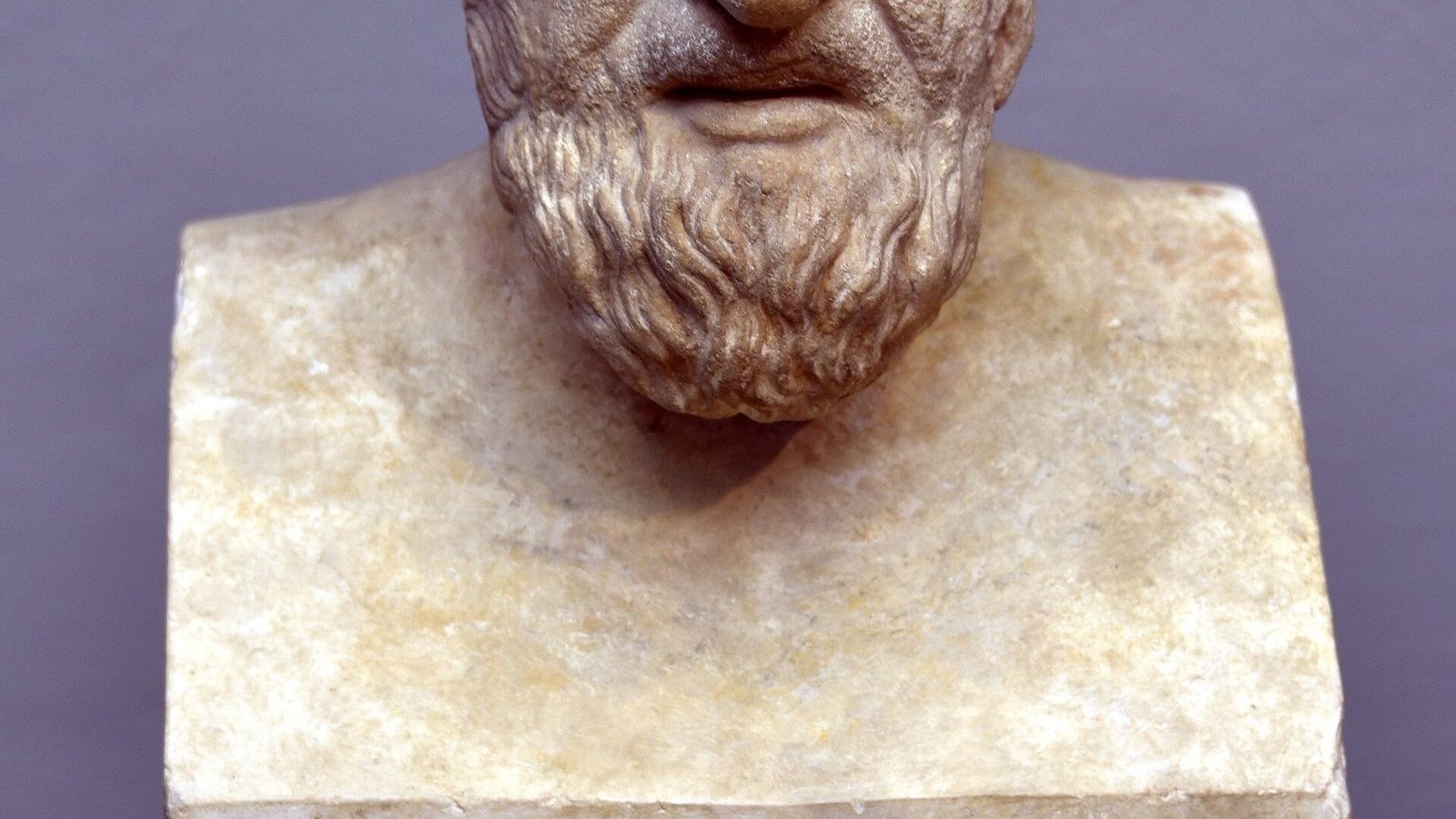
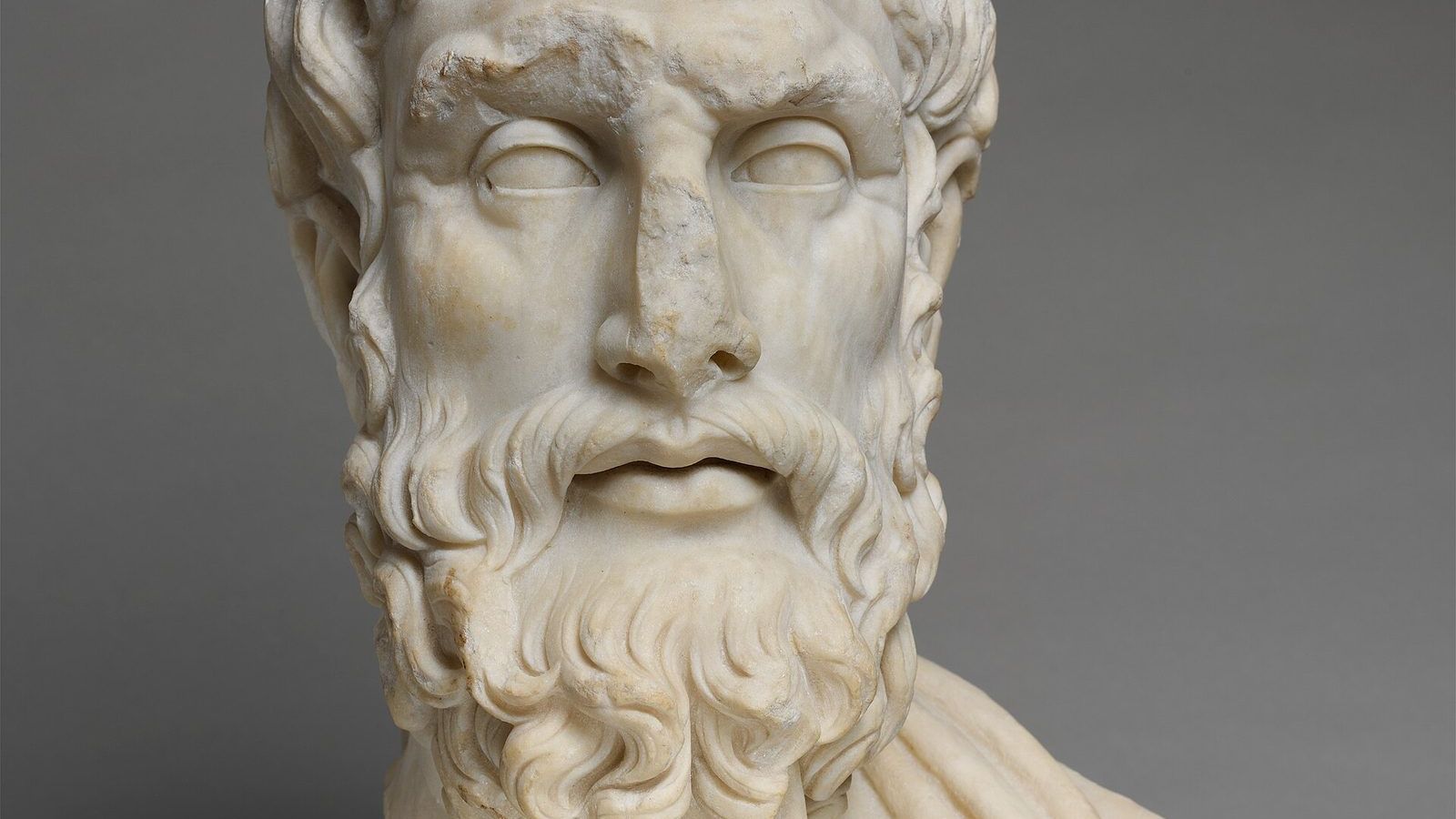
 Image: Marble head of Epicurus, Roman copy of a Greek original of the third century BC, Metropolitan Museum of Art, CC0, via Wikimedia Commons
What did Epicurus mean by pleasure?
Epicurus was born on Samos in 341 BC, taught in Mytilene and Lampsacus, and in 307 or 306 BC bought a house with a garden outside the walls of Athens, where he lived and taught until his death in 270. The school was called the Garden after it. He wrote, according to Diogenes Laertius (10.26), about 300 rolls, of which three letters, a collection of forty short sayings called the Principal Doctrines, and some fragments survive, nearly all of them preserved because Diogenes copied them into the last book of his Lives of the Eminent Philosophers. The central claim of the school is that pleasure is the beginning and the end of the blessed life. What Epicurus meant by that has been misunderstood since his own lifetime.
The complaint he answered in advance
In the Letter to Menoeceus (131 to 132), Epicurus writes that when we say pleasure is the end, we do not mean the pleasures of the dissolute or those that consist in consumption, as some people think who are ignorant, or disagree, or misunderstand; we mean freedom from pain in the body and from disturbance in the soul. It is not drinking and revelry, he goes on, nor the enjoyment of fish and the other things of an expensive table, that make life pleasant, but sober reasoning, which searches out the causes of every choice and avoidance and drives out the beliefs that cause the greatest confusion in the soul.
The word for freedom from disturbance is ataraxia, and the word for freedom from bodily pain is aponia. Together they are what Epicurus means by the highest pleasure. That is a definition, not a recommendation of abstinence for its own sake, and everything else in the theory follows from it.
The limit of pleasure
The third of the Principal Doctrines states the thesis that does most of the work: the limit of the magnitude of pleasures is the removal of all pain. Wherever pleasure is present, for as long as it is present, there is no pain in the body or distress in the soul, or both together. The claim is that pleasure does not increase without limit. Once pain and want have been removed, what remains is a state, and that state is the most pleasant a human being can be in. Further pleasures do not make it more pleasant; they vary it. A hungry person who eats bread reaches the limit. A full person who then eats a delicacy varies the pleasure but does not raise it.
Diogenes Laertius (10.136) records the distinction in the school's own words: there are static pleasures, which are states, such as freedom from disturbance and freedom from pain, and kinetic pleasures, which are motions, such as joy and delight. The static ones are the goal. The kinetic ones are welcome and harmless as long as they do not bring pain after them, and the whole of Epicurean practical advice is a calculation of which pleasures bring pain in their train. Epicurus is explicit that there is nothing wrong with any pleasure as such (KD 8). The trouble is in the consequences, and the calculation is the work of reason.
Three kinds of desire
The Letter to Menoeceus (127) sorts desires into three kinds. Some are natural and necessary: for food, for drink, for shelter, for the absence of pain, for the company of friends. Some are natural but not necessary: for a particular food, for a fine house. Some are neither natural nor necessary: for fame, for crowns and statues, for wealth beyond use. The first kind are easy to satisfy, because the body asks for little. The third kind cannot be satisfied at all, because they have no natural limit; the person who wants to be famous never arrives at enough. The second kind are the interesting ones, to be enjoyed when they come and not pursued at the cost of disturbance.
This is where bread and water come in. Epicurus writes (Letter to Menoeceus 130 to 131) that plain food gives as much pleasure as an expensive diet once the pain of want is removed, and that bread and water give the highest pleasure when someone who needs them takes them. The point is not that plain food is virtuous. It is that a person who can be content with plain food is not at the mercy of fortune, and is better placed to enjoy luxury when it happens to come, because he does not need it. The famous letter to a friend asking for a pot of cheese, so that I may have a feast when I wish (Diogenes Laertius 10.11), is the same thought in a single sentence.
Pleasure and the fear of death
The largest disturbance of the soul, in Epicurus' view, is the fear of death, and the removal of that fear is the largest part of the pleasant life. His argument is at Letter to Menoeceus 124 to 125: death is nothing to us, because all good and evil consist in sensation, and death is the end of sensation. While we exist, death is not present; when death is present, we do not exist. So it concerns neither the living nor the dead. The argument has been attacked since antiquity, and Unit 7 of the masterclass sets it out as premises and a conclusion and looks at the strongest objection, that being deprived of a future can be bad for a person even if nothing is felt. Whether it works or not, it shows what Epicurus thought pleasure was for: a life without groundless fear.
Friends, politics, and the Garden
Two more parts of the doctrine surprise people who know only the word epicure. Friendship is treated as among the greatest of the means to a happy life (KD 27), and the Garden was a community of friends who ate together, which included women and slaves among its members, an unusual arrangement in Athens. And the Epicurean was advised to keep out of public life, in the famous phrase live unnoticed, because political ambition is a desire of the third kind and the source of endless disturbance. A later Epicurean, Philodemus of Gadara, whose works were found in the villa at Herculaneum, wrote a whole treatise on how to manage property with as little trouble as possible, and the newest readings from the burnt scrolls are about exactly this question, whether scarce things give more pleasure than plentiful ones. The school's answer was always no.
Reading the texts
Everything of Epicurus that survives in his own words fits in forty pages. Diogenes Laertius' tenth book, which contains the letters and the Principal Doctrines, is on the Perseus Digital Library in Greek and in R. D. Hicks' translation of 1925. The Stanford Encyclopedia's article on Epicurus by David Konstan covers the physics, the theory of knowledge, and the ethics with the sources, and the long Roman poem by Lucretius, On the Nature of Things, written in the first century BC, is the fullest ancient statement of the system by a follower. Unit 7 of the masterclass reads the Letter to Menoeceus alongside the Stoics and the Sceptics, who disagreed with Epicurus about almost everything except that philosophy exists to make a life go well.