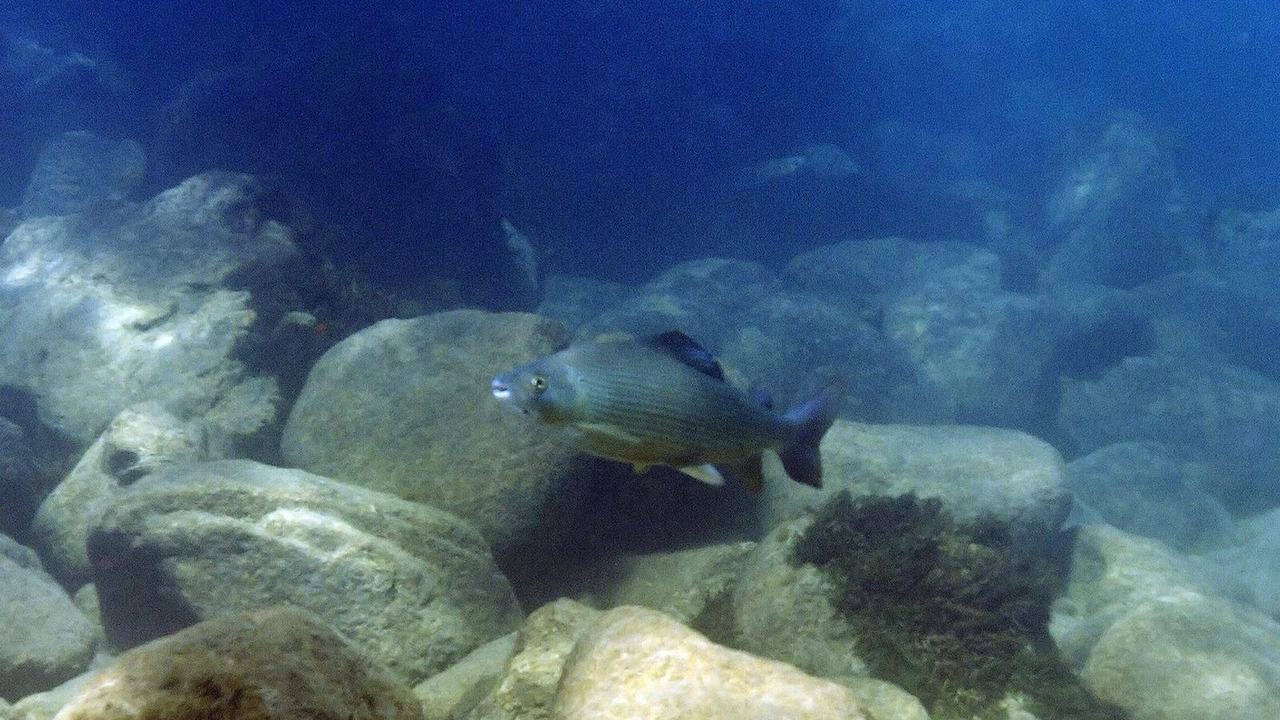
 Image: A grayling in the clear water of the river Drina. Photograph by Liquid Art, CC BY-SA 4.0, via Wikimedia Commons
Zhuangzi and the happy fish: a debate about other minds
The Zhuangzi is a collection of stories, arguments, and parodies attributed to Zhuang Zhou, who lived in the late fourth century BC, and to his followers. The seventeenth chapter, Autumn Floods, ends with a short exchange that has been debated in China for two thousand years and in the West for about a hundred. It takes a minute to read. Zhuangzi and his friend Hui Shi, a logician and a minister of the state of Wei, are walking on a bridge over the river Hao.
The exchange
Zhuangzi says: the minnows come out and swim about at their ease; this is the happiness of fish. Hui Shi says: you are not a fish; how do you know the happiness of fish? Zhuangzi says: you are not I; how do you know that I do not know the happiness of fish? Hui Shi says: I am not you, so certainly I do not know what you know; but you are certainly not a fish, so the case that you do not know the happiness of fish is complete. Zhuangzi says: let us go back to the beginning. When you said how do you know the happiness of fish, you already knew that I knew it, and asked me how. I know it from up here on the Hao.
That is the whole passage. The question is who won.
The moves
Unit 16 of the masterclass sets out the five moves as an argument, and the shape is clearer than it looks. Hui Shi's first question rests on a principle: to know what a creature feels, you must be that creature. Call it the principle of access. Zhuangzi's reply turns the principle against its owner. If access requires identity, then Hui Shi, who is not Zhuangzi, cannot know what Zhuangzi knows, and so cannot know that Zhuangzi does not know about the fish. The principle undercuts the objection made with it.
Hui Shi's second move is the strongest in the passage, and it is often underrated. He accepts the consequence. Yes, he says, I am not you, and so I do not know what you know; that is exactly my point, applied consistently. And you are not a fish, so by the same principle you do not know what the fish feel. The principle of access, applied to everyone, gives Hui Shi what he wanted: nobody knows another creature's mind, Zhuangzi included. He has not been refuted; he has been shown to be a thoroughgoing sceptic about other minds, and he has accepted it.
Zhuangzi's last move does two things. The first is a point of logic. Hui Shi's original question was not do you know the happiness of fish but how do you know it, and a question of the form how do you know X presupposes that the person knows X. Hui Shi, Zhuangzi says, has conceded the knowledge in the act of asking for its source. The second is a pun. The Chinese word an, which Hui Shi used to mean how, also means where, whence. So Zhuangzi answers the question as if it had asked where he knows it from, and says: from here, on the bridge over the Hao. The answer is a joke, and it is also a claim: that one knows the happiness of fish in the way one knows most things about other creatures, by watching them, in a particular place, and not by being them.
Who is right
Readers divide. On a strict reading Hui Shi wins the argument and Zhuangzi escapes with a pun: the presupposition point is a trick, since how do you know can perfectly well be a challenge rather than a concession, and Hui Shi's second move has already closed the case. On a more generous reading, which Chris Fraser of the University of Hong Kong has defended in his work on the Zhuangzi, the pun is the argument. Hui Shi's principle of access is false, and Zhuangzi shows it to be false by pointing to the ordinary situation in which everyone, including Hui Shi, attributes feelings to others on the basis of what they see. The fish swim at their ease; that is what the happiness of fish looks like; and a demand for some further access to their inner life is a demand that could never be met for any creature, Hui Shi included, and that nobody actually makes.
The first reading takes the passage as a logic lesson. The second takes it as a lesson about logic lessons: Hui Shi, the professional arguer, has a principle that proves too much, and Zhuangzi declines to play by it. The Zhuangzi as a whole supports the second reading, since the book is full of arguments against the idea that disputation can settle anything, and Hui Shi appears in it repeatedly as the friend whose cleverness Zhuangzi enjoys and does not trust. The last chapter of the book says that Hui Shi had many methods and his writings filled five carts, and that his teachings were contradictory and his words missed the mark.
The problem of other minds
Philosophers in the West came to the same question late and from another direction. The problem of other minds, as it was named in the twentieth century, asks how anyone can know that other people have experiences at all, given that each of us has direct access only to our own. The standard answers are inference from analogy, which says that since others behave as I do when I feel pain they probably feel pain too, and the view that attributing feelings to others is not an inference at all but part of what it is to see a creature behaving. Hui Shi is the sceptic who denies that either answer gives knowledge. Zhuangzi, on the generous reading, is the second answer: he knows the fish are happy from the bridge, because that is where such things are known from.
Unit 16 reads the passage next to the butterfly dream at the end of chapter 2, where Zhuangzi wakes and does not know whether he is a man who dreamed he was a butterfly or a butterfly dreaming it is a man, and asks whether the two passages make the same point from two sides: that the boundary between one creature's perspective and another's is less solid than the logicians need it to be.
Reading it
The passage is the last paragraph of chapter 17 of the Zhuangzi, and it is on the Chinese Text Project with Legge's translation of 1891 beside the Chinese. The masterclass cites chapters by number and by the titles of Burton Watson's translation, so the passage is Zhuangzi 17, Autumn Floods. The Stanford Encyclopedia's article on Zhuangzi by Chad Hansen takes a view of the whole book, and Fraser's reading of the fish is in his published work on the text, listed in the unit's further reading. Read the Chinese if you can, even slowly, for the word an in Hui Shi's first question. Everything turns on it.