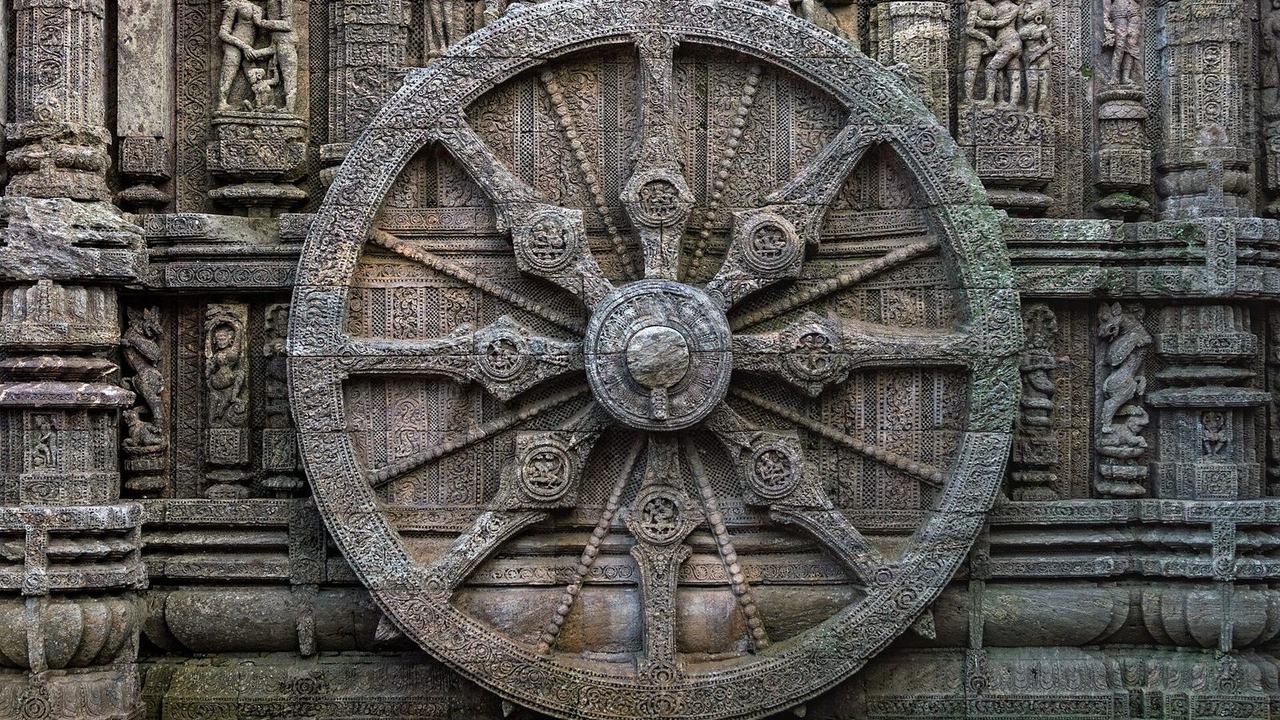
 Image: A stone wheel of the thirteenth-century Sun Temple at Konark, Odisha, which is built in the form of a chariot. Photograph by Subhrajyoti07, CC BY-SA 4.0, via Wikimedia Commons
The chariot argument: Nagasena, King Milinda, and the self
Menander was a Greek king who ruled in the Punjab in the second century BC, one of the successors of the Greek kingdoms that Alexander's generals had left in Bactria and northern India. His coins survive by the thousand. In the Buddhist tradition he is Milinda, and the Milindapanha, the Questions of Milinda, is a Pali text in which he debates with a monk named Nagasena. The earliest parts of the book were written some time between 100 BC and AD 200, and the first conversation in it, which fills a few pages, has been the standard example of a Buddhist argument ever since.
The conversation
The king comes to the monk and asks his name. I am known as Nagasena, the monk replies; but Nagasena is only a name, a label, a designation in common use, for there is no person to be found here. The king is delighted and turns to the crowd: if there is no person, who receives the robes and food that are given to him? Who keeps the precepts? Who attains the goal? And if there is no person, there is no one who kills, no one who steals, no act and no consequence of an act. So, he says, Nagasena, is the hair your self? No. The nails, the skin, the bones? No. Is form your self, or feeling, or perception, or the mental formations, or consciousness? No. Is Nagasena all of these together? No. Is he something apart from them? No. Then, says the king, I can find no Nagasena. Nagasena is an empty sound. Who is it that speaks to me? You tell a lie.
The monk then asks the king how he came: on foot or in a chariot? In a chariot. Then is the pole the chariot? No. The axle, the wheels, the frame, the yoke, the reins, the goad? No, no. Is the chariot all of these together? No. Is it something apart from them? No. Then, says Nagasena, I can find no chariot. Chariot is an empty sound. The king, who came in one, has told a lie. The crowd cheers, and the king gives the answer the monk wanted: chariot is a designation, a label, a name in common use, which exists in dependence on the pole, the axle, and the rest. Just so, says Nagasena, Nagasena is a name in dependence on the hair, the bones, form, feeling, and the other parts; but in the ultimate sense no person is found there. And he quotes a verse spoken by the nun Vajira in the presence of the Buddha: just as the word chariot is used when the parts are assembled, so the convention a being is used when the aggregates are present.
The argument set out
Unit 14 of the masterclass sets the exchange out as the premises and conclusion it contains, in the way the earlier units treat Plato. The first premise is that whatever a person is, it is either one of the parts, or all of them together, or something apart from them. The second is that no single part is the person: the king agrees that the hair is not Nagasena, and so for each aggregate. The third is that the parts taken together are not the person either, which the king also grants, though more quickly than he should. The fourth is that there is nothing apart from the parts to be the person. The conclusion is that no person is found; the name refers to the parts in a certain arrangement, and to nothing further. The chariot is not a second argument but the same argument run on an object nobody is tempted to think has a soul, so that the king can see that the conclusion is harmless there and must be harmless here.
The parts in question are the five aggregates, khandha in Pali: material form, feeling, perception, mental formations, and consciousness. The Buddha's own argument that none of them is a self is the Discourse on the Characteristic of Not-Self, SN 22.59, which argues from the fact that each aggregate is beyond our control and subject to change that none of them can be what we mean by self. Nagasena takes that result as given and adds the chariot.
What is claimed and what is not
The conclusion is easy to overstate. Nagasena does not say that Nagasena does not exist. He says that Nagasena is a designation, a word in common use, and that it is correctly used: the king came in a chariot, and the monk receives the robes. What he denies is that there is some further thing, over and above the parts in their arrangement, to which the name refers. Later Buddhist philosophers made the point with a distinction between two kinds of truth. In the conventional sense there are persons and chariots and the words for them are true; in the ultimate sense there are only the parts, arising and passing in dependence on one another. The teaching of not-self, anattā, is the claim that the self is conventional in that sense. It is not the claim that there is no one here.
Nor is it a claim about the soul in the Greek sense. The Buddha, asked directly by the wanderer Vacchagotta whether there is a self, stayed silent, and asked whether there is no self, stayed silent again (SN 44.10). When Ananda asked why, the Buddha said that to answer yes would have sided with the eternalists and to answer no would have confused the questioner further. Unit 14 reads that passage next to the chariot and asks whether the two are consistent. The king's worry about responsibility, who keeps the precepts and who does the deed, is the right worry, and the Buddhist answer, that actions and their results belong to the series of aggregates in the same way the chariot's motion belongs to the chariot, is set out in the unit as the strongest reply available.
The same argument elsewhere
Readers who know Western philosophy will recognize the shape. David Hume, in 1739, looked inward for the self and reported that he found only perceptions and never a self apart from them. Derek Parfit, in Reasons and Persons (1984), argued that a person is nothing over and above a brain and body and a series of connected experiences, and said in a note that he had found the same view in the Buddhist texts. The Milindapanha is the earliest full statement of it, and it is also the one that takes the objection from responsibility most seriously, because the king raises it before the monk has finished his first sentence.
Reading the text
The chariot dialogue is at the start of the third book of the Milindapanha, pages 25 to 28 in Trenckner's edition of the Pali, and it is on SuttaCentral in a modern translation by Bhikkhu Kelly, with the Pali available beside it. The Discourse on the Characteristic of Not-Self is SN 22.59 in Bhikkhu Sujato's translation, and Vajira's verse about the chariot is SN 5.10. T. W. Rhys Davids' translation of 1890 is out of copyright and is the version the masterclass quotes when it does not translate for itself. Read the chariot passage and then SN 22.59 in that order, and the shape of Unit 14 is in front of you: the Buddha's argument from control and change, and the monk's argument from parts, aimed at the same conclusion from two sides.