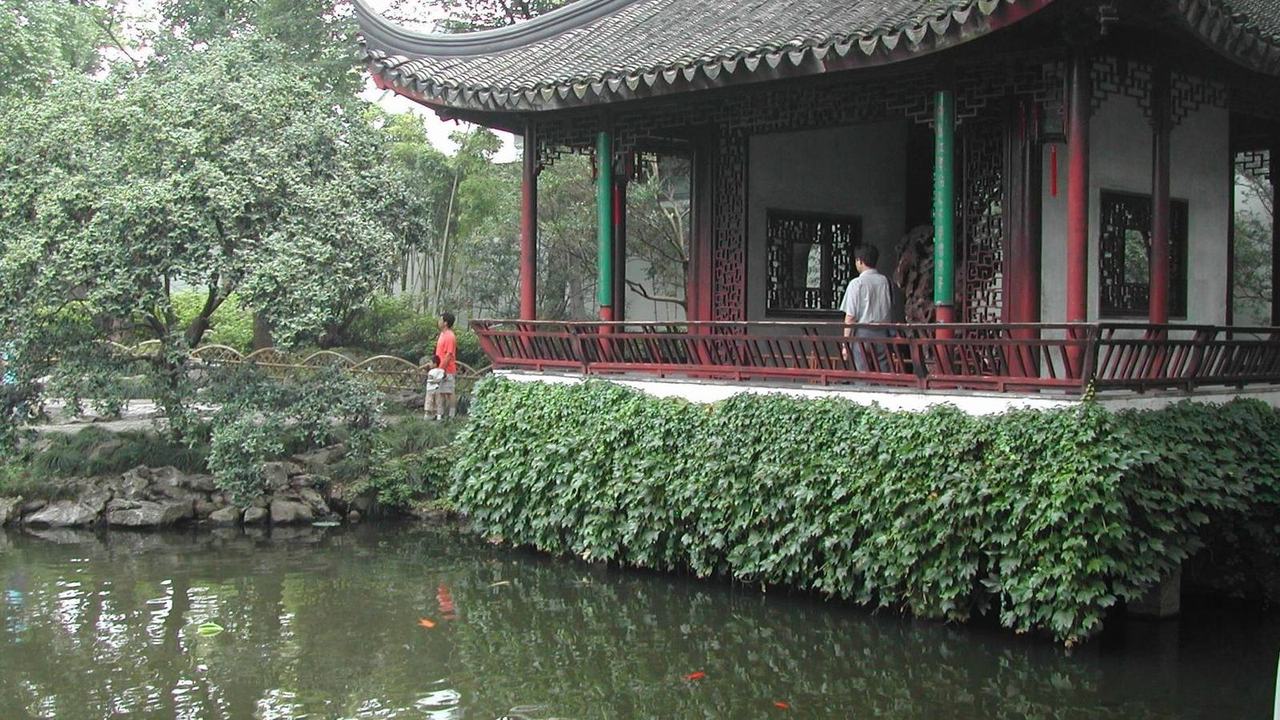
 Image: One of the classical gardens of Suzhou. Photograph by Francesco Bandarin, CC BY-SA 3.0 IGO, via Wikimedia Commons
Mencius and the child at the well: is human nature good?
Mencius, whose Chinese name is Mengzi, lived in the fourth century BC, about a century after Confucius, in the period of the Warring States, when the old order of China had broken into rival kingdoms and philosophers travelled from court to court offering advice. The book that carries his name records his conversations with kings, ministers, and rival thinkers. Its most famous argument takes six sentences and is at Mencius 2A6, in the second book, part A, passage 6.
The passage
Everyone, Mencius says, has a heart that cannot bear the suffering of others. Here is how to see it. Suppose someone suddenly sees a child about to fall into a well. Anyone in that situation feels alarm and compassion. They do not feel it because they want to get on good terms with the child's parents, nor because they want praise from their neighbours and friends, nor because they dislike the sound of the child's cry. From this, Mencius concludes, it can be seen that whoever lacks a heart of compassion is not human; whoever lacks a heart of shame is not human; whoever lacks a heart of deference is not human; and whoever lacks a heart that distinguishes right from wrong is not human. The heart of compassion is the sprout of humaneness, ren. The heart of shame is the sprout of rightness, yi. The heart of deference is the sprout of ritual propriety, li. The heart that distinguishes right from wrong is the sprout of wisdom, zhi. People have these four sprouts as they have four limbs.
The word translated sprout, duan, means a beginning or a tip, and the image is of a seed that will grow into a plant if it is tended. The four virtues are the plants. The claim is that every person is born with the beginnings of all four, and that a person who develops them becomes fully what a human being is.
The argument set out
Unit 15 of the masterclass lays this out as an argument, as it does for Aristotle's function argument in Unit 6, and the two are worth comparing. The first premise is an observation: anyone who sees the child feels alarm and compassion. The second rules out the self-interested explanations one by one: not for the parents' favour, not for reputation, not from distaste. The intermediate conclusion is that the feeling is spontaneous and not the result of calculation, which is to say that it belongs to human nature and not to upbringing or custom. The third premise, stated at 6A6 rather than here, is that what belongs to human nature is what human nature is: if the sprouts are there in everyone, nature is good in the sense that it tends towards goodness when not prevented. The conclusion is that human nature is good, xing shan.
Notice what the conclusion does not say. Mencius does not claim that people are good. He says at 6A8 that a mountain near a city, once wooded, becomes bare because people cut the trees and graze their cattle on it, and that anyone who saw it bare would think it had never had trees; so with a person whose heart has been cut down daily. The sprouts need tending, and most are not tended. The argument from the well establishes only that the sprouts are there.
Gaozi's objections
Book 6A opens with a debate between Mencius and a thinker named Gaozi, who held that human nature is neither good nor bad. Human nature, Gaozi says, is like a willow tree, and rightness is like cups and bowls: making people good is like carving the wood. Mencius asks whether the carving follows the nature of the willow or does violence to it, and says that if it does violence, then Gaozi's view makes morality a mutilation. Gaozi tries again: nature is like water, which flows east if you open a channel east and west if you open one west. Mencius agrees that water does not prefer east or west, but asks whether it prefers up or down. It flows down. Human nature tends to goodness as water tends downward; you can make it go up by striking it, as you can make people do wrong by force of circumstance, but that is not its nature.
These exchanges show what kind of claim Mencius is making. It is a claim about tendencies, about what develops when nothing interferes, and it is defended by analogy and by observation of what people do when caught off guard. The child at the well is the best observation he has, because the suddenness removes the time to calculate.
Xunzi's answer
Xunzi, writing in the third century BC, about a generation after Mencius' death, gave the opposite answer in a chapter whose title is the thesis: Human Nature Is Bad (Xunzi 23). People are born, he says, with a love of profit, with envy and hatred, and with desires of the eye and ear; if they follow these, the result is strife, cruelty, and disorder. Goodness is wei, conscious activity or artifice, the work of teachers, rituals, and standards built up by the sages over generations. A warped piece of wood must be steamed and pressed to be made straight; a blunt blade must be ground. Mencius, Xunzi says directly, failed to understand the difference between nature and artifice.
Xunzi's strongest point is a question. If human nature were good, what would sages and rituals be for? Why does every society need laws and teachers? Mencius' reply, which he gave in advance at 6A7 and 6A8, is that the sprouts need cultivation precisely because they are sprouts, and that the sages are the people who tended theirs fully and then showed others how. The two agree about almost everything that matters in practice, the need for education, ritual, and good government. They disagree about what the education is doing: drawing out what is there, or building what is not.
How the dispute looks now
Bryan Van Norden of Vassar College, whose work on Mencius is the Research Spotlight of Unit 15, has argued that the disagreement is partly about what nature means. For Mencius, nature is what a thing becomes under favourable conditions, as the nature of a seed is the tree; for Xunzi, nature is what a thing is at birth before anything is done to it. On those definitions both can be right about the facts and still disagree about the word. The dispute has a modern echo in the arguments about whether moral emotions are innate, and the child at the well is routinely cited in that literature as the oldest clean thought experiment on the question. It has one advantage over many of its successors. Anyone can test it, by imagining the well and noticing what they feel before they have had time to think.
Reading the texts
The Mencius is on the Chinese Text Project with James Legge's translation of 1861 beside the Chinese; the passage is section 6 of the chapter Gong Sun Chou I. Xunzi's chapter is on the same site under Xing E, Human Nature Is Bad. The masterclass cites the Mencius by the standard divisions, 2A6 and 6A6, which match the chapter and section numbers on the site, and it translates ren as humaneness and li as ritual throughout, with the reasons given once in Unit 15. The Stanford Encyclopedia's article on Mencius by Bryan Van Norden gives the dispute with Xunzi in full and the modern readings of it.