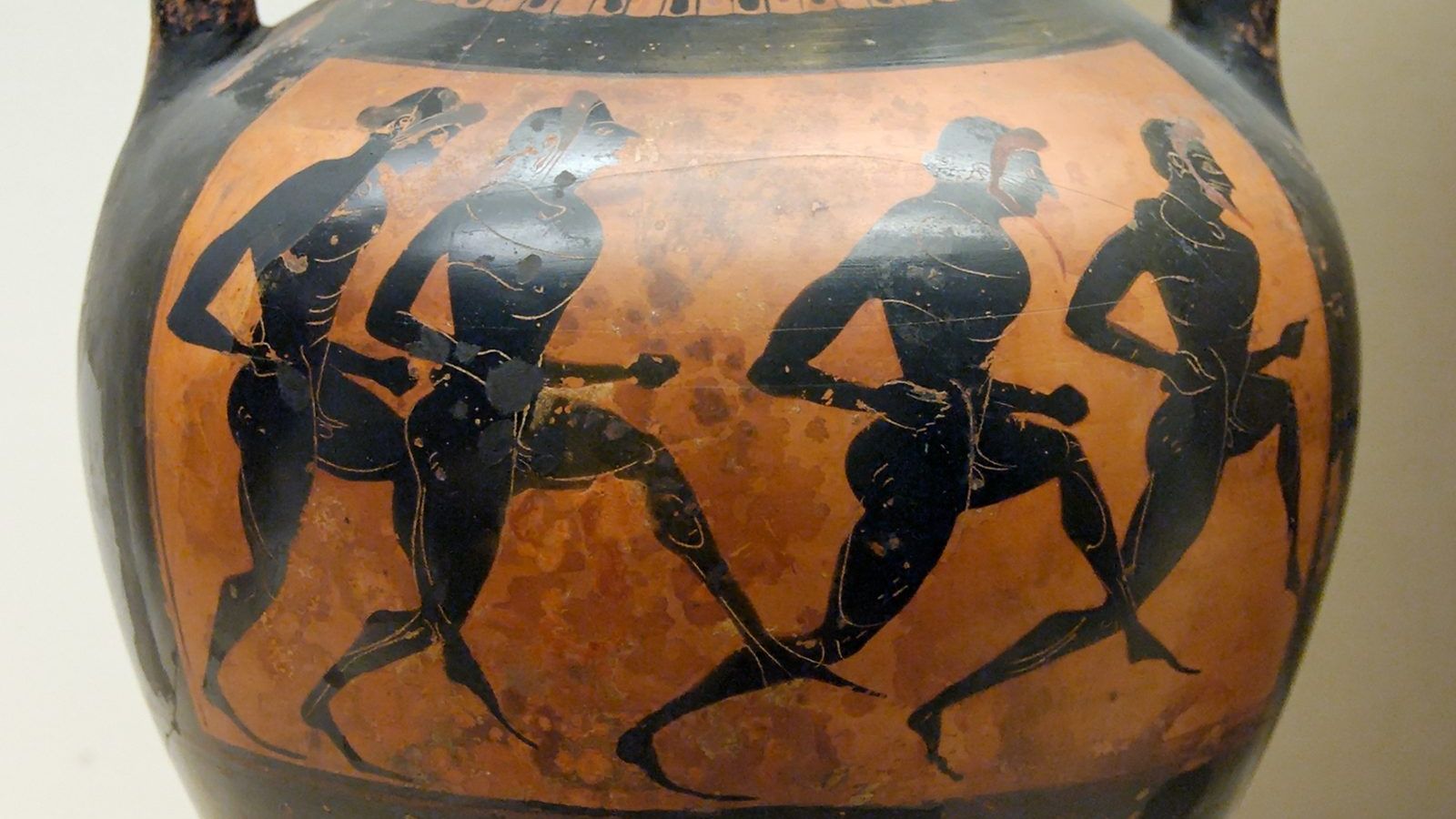
 Image: Runners on a Panathenaic prize amphora attributed to the Euphiletos Painter, about 530 BC, British Museum, public domain, via Wikimedia Commons
Zeno's paradox explained: how Achilles catches the tortoise
Zeno of Elea lived in the fifth century BC and wrote a book of arguments, now lost, in defence of his teacher Parmenides, who had argued that what is cannot change or move. Zeno's method was to take the ordinary belief that things move and show that it leads to absurdities. Aristotle preserved four of the arguments about motion in book VI of the Physics, and the second of them, at 239b14, is the one everyone knows. Here it is in Aristotle's words, more or less: the slowest runner will never be caught by the fastest, because the pursuer must first reach the point from which the pursued started, so that the slower must always be some distance ahead.
The race with numbers
Give the tortoise a head start of 100 metres. Let Achilles run at 10 metres a second and the tortoise at 1 metre a second, which is generous to the tortoise and makes the arithmetic clean. Achilles reaches the tortoise's starting line after 10 seconds. In those 10 seconds the tortoise has moved 10 metres. Achilles covers those 10 metres in 1 second, during which the tortoise moves 1 metre. Achilles covers that metre in a tenth of a second, during which the tortoise moves a tenth of a metre. And so on. At every stage, when Achilles arrives where the tortoise was, the tortoise has moved on.
Add up the distances Achilles runs: 100 + 10 + 1 + 0.1 + 0.01 + ... This is a geometric series with first term 100 and ratio one tenth, and its sum is 100 divided by (1 minus one tenth), which is 111.11 metres, recurring. Add up the times: 10 + 1 + 0.1 + ... seconds, which is 11.11 seconds, recurring. Check it the direct way: Achilles gains 9 metres a second on a 100-metre lead, so he draws level after 100/9 seconds, which is 11.11 seconds, having run 111.11 metres. The two methods agree. Achilles catches the tortoise 111 and one ninth metres from his own start, 11 and one ninth seconds after the gun.
That is the solution usually offered, and as far as it goes it is right. The infinitely many stages Zeno describes take up a finite distance and a finite time, because each stage is a tenth of the one before and the tenths add up to something finite. The Greeks did not have the theory of convergent series in this form; it was worked out in the seventeenth century and made rigorous in the nineteenth. Zeno could not have answered his own argument this way, and the mathematics is a real advance on him.
What the sum does not settle
Now read Zeno's argument again. He did not say that the distances add up to something infinite. He said that Achilles must complete infinitely many stages, one after another, and that a sequence with no last member cannot be finished. The sum of the series tells you where the finishing point is. It does not tell you how a runner gets through infinitely many stages to arrive there. The series has a limit; it does not have a last term. Achilles' run, if Zeno's description is correct, has no last step before the catch, and yet the catch happens.
Philosophers in the twentieth century gave this residue a name, the supertask: a task that consists of infinitely many sub-tasks completed in a finite time. Max Black argued in 1951 that the very idea was incoherent, and James Thomson in 1954 invented the lamp that is switched on at half a minute, off at three quarters, on at seven eighths, and so on: after one minute, is it on or off? There is no answer, and Thomson took that to show that supertasks cannot be completed. Paul Benacerraf replied in 1962 that the description of the lamp simply fails to specify its state at the one-minute mark, so nothing follows about whether the switching could be done. The argument is still going, and the Stanford Encyclopedia's article on Zeno's paradoxes by Nick Huggett sets out the current positions.
Aristotle's answer
Aristotle had an answer of his own, and it is still one of the best. In Physics VIII 8 (263a4 to b9) he distinguishes between a distance that is divided into infinitely many parts and a distance that is divisible into them. The track between Achilles and the tortoise is divisible without end: you can always mark another halfway point. But the runner does not have to pass through the marks unless someone has made them. Divisions that are merely possible, Aristotle says, are not actually there to be crossed, and a runner crosses a continuous stretch as one motion, not as a sequence of infinitely many motions. On this view Zeno has confused what can be done to a distance in thought with what a runner does on the track.
That reply rests on Aristotle's distinction between potential and actual infinity, which Unit 9 of the masterclass sets out in full. It has a cost: it denies that the infinitely many stages Zeno describes are real stages of the run, which many readers find hard to accept once they have seen the series written out. Whether the stages are real is a question about what motion is, and no amount of arithmetic answers it.
The other three arguments
Zeno's arguments were designed as a set, and the Achilles is the one that survives mathematics best. The dichotomy (239b11) is its mirror image: before reaching the end of the track a runner must reach the halfway point, and before that the quarter point, and so on, so that there is no first step and the run cannot begin. The arrow (239b5) argues that at any instant a flying arrow occupies a space exactly its own size and is therefore at rest, and that a flight made of rests is no flight. The stadium (239b33) concerns rows of bodies passing each other at equal speed and seems to show that a given time equals twice itself. Aristotle thought the arrow rested on the false assumption that time is made of instants, and Unit 9 looks at whether modern physics, which does treat time as made of instants, has anything to say to Zeno.
Why Zeno still matters
It is tempting to file Zeno as a clever man who lacked calculus. Bertrand Russell, who had the calculus, wrote in 1903 that Zeno's arguments were in some form the foundation of nearly all the work on infinity since. He meant that the questions Zeno raised about division, continuity, and the completion of infinite sequences became, two thousand years later, the questions that Cantor's theory of infinite sets and Weierstrass's theory of limits were built to answer. The answers are better than Zeno's. The questions are his.
The habit the masterclass tries to teach with Zeno is to separate what a calculation settles from what it does not. The sum of the series settles where and when Achilles draws level. Whether a runner can complete infinitely many stages is a question about motion and about infinity, and the honest answer is that there are several good answers and no agreed one. A participant who can say which part of the problem the arithmetic solves, and which part it leaves, has understood Zeno better than most of the people who quote him.