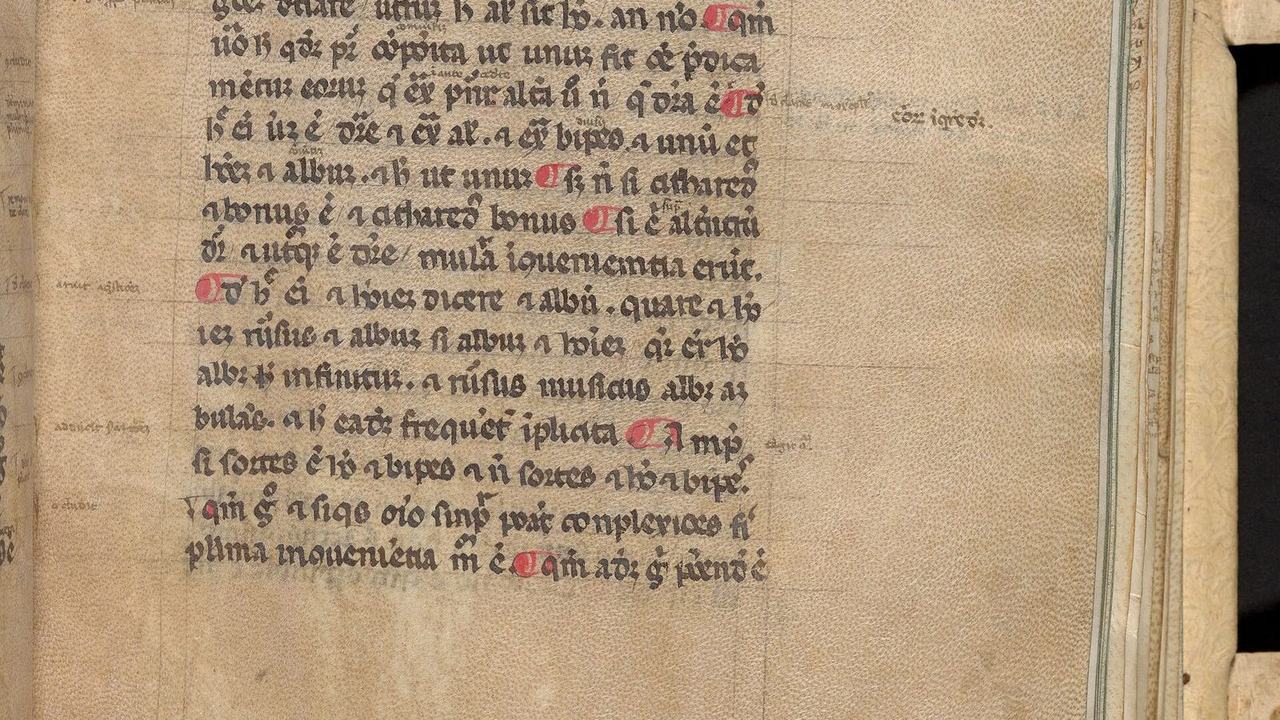
 Image: A page of a Spanish manuscript of works on logic by Aristotle, Porphyry, and Boethius, Boston Public Library, public domain, via Wikimedia Commons
Barbara, Celarent, Darii, Ferio: the names of the syllogisms
Every philosophy student of the thirteenth century could recite them, and a good many still can: Barbara, Celarent, Darii, Ferio. They sound like a list of saints or a spell. They are the names of the four valid syllogisms of Aristotle's first figure, and each name is a small machine that tells you the shape of the argument and how to prove that it works. The full verse runs to nineteen names, and this article explains how to read all of them.
What a syllogism is
Aristotle's Prior Analytics, written in the fourth century BC, is the first systematic treatment of valid argument. The arguments it studies have two premises and a conclusion, and each of the three sentences is of one of four forms. Every S is P. No S is P. Some S is P. Some S is not P. The medieval logicians labelled these A, E, I, and O, from the vowels of the Latin words affirmo (I affirm) and nego (I deny): A and I for the two affirmative forms, E and O for the two negative ones.
The three sentences share three terms. The term that appears in both premises but not in the conclusion is the middle term; the two others are the subject and the predicate of the conclusion. Aristotle sorted syllogisms into figures by where the middle term sits. In the first figure it is the subject of one premise and the predicate of the other: every M is P, every S is M, so every S is P. That is the shape Aristotle took as basic, because its validity is obvious at a glance.
Reading a name
Take Barbara. Its three vowels are A, A, A: both premises and the conclusion are universal affirmatives. Every M is P; every S is M; therefore every S is P. Every mammal is an animal; every dog is a mammal; therefore every dog is an animal. The consonants of Barbara carry no instructions, because Barbara needs no proof: it is one of the four forms Aristotle called perfect, whose validity is evident without further argument.
Celarent has the vowels E, A, E. No M is P; every S is M; therefore no S is P. No fish breathes air; every trout is a fish; therefore no trout breathes air. Darii is A, I, I: every M is P; some S is M; so some S is P. Ferio is E, I, O: no M is P; some S is M; so some S is not P. These four are the first figure, and they are the whole of what Aristotle considered self-evident.
The other figures and the consonants
Arguments in the other figures are valid too, but Aristotle proved them by turning them into first-figure arguments, and the consonants of their names record how. The second figure, in which the middle term is the predicate of both premises, has Cesare, Camestres, Festino, and Baroco. The third, in which it is the subject of both, has Darapti, Felapton, Disamis, Datisi, Bocardo, and Ferison. A fourth figure, which Aristotle did not treat separately, was added later with Bramantip, Camenes, Dimaris, Fesapo, and Fresison.
The first letter of each name is the first letter of the first-figure form it reduces to. Cesare and Camestres begin with C because they reduce to Celarent; Festino and Fresison reduce to Ferio; Darapti, Disamis, and Datisi reduce to Darii; Bramantip, Baroco, and Bocardo reduce to Barbara. The letter s after a vowel means that the sentence of that vowel is converted simply: no M is P becomes no P is M, and some S is M becomes some M is S, without change of meaning. The letter p means conversion by limitation: every P is M becomes some M is P. The letter m means that the two premises are swapped. The letter c, found only in Baroco and Bocardo, means that the proof goes by contradiction: assume the conclusion false and derive a contradiction with a premise using Barbara. Every other consonant is filler to make the name pronounceable.
Try it on Cesare: E, A, E in the second figure. No P is M; every S is M; therefore no S is P. The s after the first vowel says convert the first premise: no M is P. Now the argument is no M is P, every S is M, therefore no S is P, which is Celarent. The name has told you the proof.
Where the verse comes from
The names first appear in the logic textbooks of the thirteenth century. William of Sherwood's Introductiones in logicam, written at Oxford around 1250, gives the verse in a form close to the one still taught, and Peter of Spain's Summulae logicales, from about the same time, spread it through every university in Europe. Nobody knows who invented the names. They are the kind of thing that circulates among teachers before anyone writes it down, and they belong to the medieval schools rather than to Aristotle, who identified the forms but never named them. The Stanford Encyclopedia's article on medieval theories of the syllogism gives the history and the variants.
How many valid forms there are
Aristotle's own count in the Prior Analytics gives fourteen valid forms in the three figures. The medieval lists add the fourth figure and reach nineteen, which is what the verse names. Five more are valid but weaker than they need to be, because they draw a particular conclusion where a universal one was available; the complete list with those added has twenty-four. The number depends on one assumption that the medieval logicians made and modern logic does not: that the terms are not empty. Darapti infers some S is P from every M is P and every M is S, which fails if there are no M. The masterclass follows the traditional count, states the assumption, and shows in Unit 10 exactly where it bites.
Using the names to test an argument
The practical value of the verse is that it turns a question about validity into a lookup. Put the argument into standard form: identify the three terms, write each sentence as A, E, I, or O, and find the figure from the position of the middle term. Then look for a name with those vowels in that figure. If there is one, the argument is valid and the consonants show you why. If there is none, the argument is invalid, and you can usually see the counterexample by trying to build one with ordinary terms.
Some politicians are liars; some liars are rich; therefore some politicians are rich. Both premises are I, the conclusion is I, the middle term (liars) is predicate of the first premise and subject of the second: first figure, I, I, I. There is no such name. The argument is invalid, and the counterexample comes easily: the politicians who lie and the liars who are rich may be different people. Unit 10 of the masterclass teaches this test with Aristotle's own examples, builds the square of opposition that underlies the conversions, and then gives you a free online proof checker to confirm your answers.
What the names do not do
The syllogism covers arguments whose sentences have the four forms and no others. Most arguments in ordinary life, in science, and in philosophy are not like that: they involve relations (A is taller than B), several quantifiers in one sentence, or sentences joined by if and or. The Stoics, a generation after Aristotle, built a logic of if and or that handles the last of these, and Unit 11 reads it. The logic of relations and multiple quantifiers waited until Frege in 1879. Within its range the syllogism is complete and exact, and the names are the fastest way ever devised to carry that range in your head. Aristotle's text itself, with its proofs, is in the Stanford Encyclopedia's article on Aristotle's logic, which also explains why the reductions work.